
Microsoft has launched AI Performance inside Bing Webmaster Tools, giving publishers the first direct visibility into how their content is used in AI-generated answers.
This is a structural shift.
For years, generative AI systems have cited web content inside conversational responses. But traditional SEO tools only measured clicks and rankings, not AI citations. That gap created a new blind spot in organic strategy.
This report closes it (partially) and signals the rise of Generative Engine Optimization (GEO).
The AI Visibility Problem: Why SEOs Were Flying Blind
The Reality
Generative AI models use web content to:
- Train systems
- Ground answers
- Cite sources inside AI-generated responses
The Problem
Search Console-style reports track:
- Impressions
- Clicks
- CTR
- Average position
They do not track:
- AI citations
- LLM grounding events
- Conversational triggers
The Result
Publishers had no way to measure whether AI systems trusted or cited their content.
Until now.
What Is Bing’s AI Performance Report?
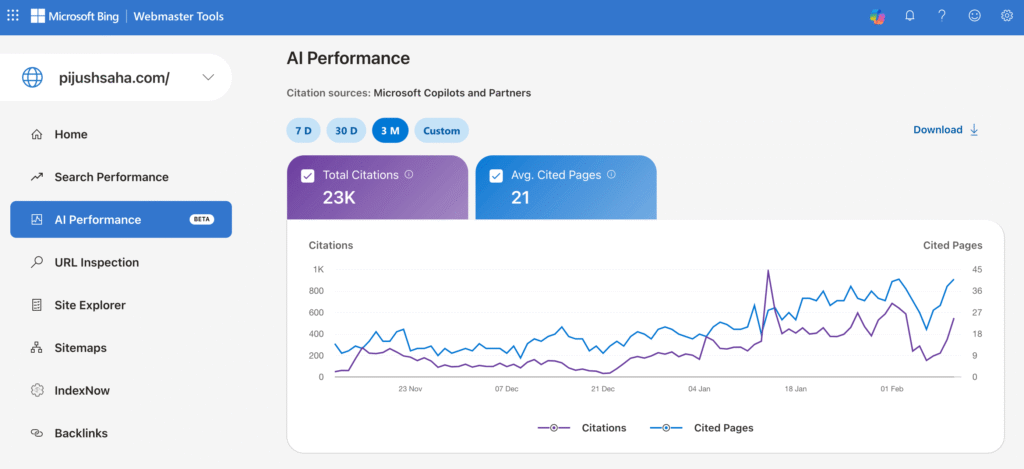
Microsoft introduced a new dashboard inside Bing Webmaster Tools called AI Performance.
It is the first dedicated reporting layer that tracks how your site is used in AI-generated answers across Bing’s AI experiences.
It moves beyond “blue links” to “AI citations.”
This marks the beginning of measurable AI attribution.
The 5 Core Metrics Explained (With SEO Context)
1. Total Citations (The New Impression Metric)
Definition: The total number of times your site is cited as a source in AI-generated answers.
Why It Matters
This functions like AI impressions.
It signals:
- Authority inside the model
- Trustworthiness
- Knowledge base inclusion
If rankings measure search visibility, citations measure AI trust.
2. Average Cited Pages (Breadth of Authority)
Definition: The daily average of unique URLs cited by AI systems.
Why It Matters
- Low number → AI trusts one strong page.
- High number → AI trusts your ecosystem.
This metric reflects topical authority depth, not just one high-performing URL.
For semantic SEO, this validates content clusters and entity coverage.
3. Grounding Queries (The Game Changer)
Definition: The specific conversational phrases that triggered AI to reference your content.
These are not traditional keywords.
They are:
- Natural language prompts
- Question-based triggers
- Problem-focused phrasing
Why This Is Critical for GEO
Grounding queries reveal:
- How AI interprets your expertise
- What topics you’re trusted for
- Which conversational intents activate your content
This is the clearest bridge between:
- Search behavior
- LLM reasoning
- Entity authority
4. Page-Level Citation Activity
Definition: Citation counts broken down by URL.
Example:
| URL | Citations | Trend |
|---|---|---|
| /blog/technical-seo-guide | 520 | ↑ |
| /products/analytics-suite | 310 | flat |
| /support/api-docs | 150 | ↑ |
What This Reveals
- Which pages AI considers most reliable
- Which documents function as “knowledge anchors”
- Where structure and clarity are working
Pages with rising citation trends are often:
- Well-structured
- Fact-supported
- Entity-consistent
- Updated frequently
5. Visibility Trends Over Time
Definition: Timeline view of citation growth or decline.
Why It Matters
You can now track:
- Momentum after content updates
- Impact of entity expansion
- Authority shifts across topics
This is early-stage AI performance trend analysis.
The Critical Caveat: Citations ≠ Clicks
The AI Performance dashboard tracks:
- Citation frequency
It does not track:
- Traffic
- Click-throughs
- Conversions
- Revenue
You can see your content is being used, but you cannot yet directly attribute ROI from this data alone.
This is authority measurement, not performance marketing.
From SEO to GEO (Generative Engine Optimization)
Traditional SEO focused on:
- Ranking in blue links
- Capturing clicks
GEO focuses on:
- Being cited inside AI answers
- Becoming a trusted knowledge source
The sites that win won’t just rank. They’ll be the ones AI systems trust enough to cite.
This shifts optimization toward:
- Entity clarity
- Structured information
- Factual grounding
- Topical completeness
Actionable GEO Tactics (Based on Bing’s Framework)
1. Structure for Machine Readability
Use:
- Clear H2/H3 headings
- Lists
- Tables
- FAQ blocks
- Definition-style sections
AI systems extract structured segments more easily than dense prose.
2. Strengthen Factual Grounding
Support claims with:
- Data
- Sources
- Definitions
- Entity references
Avoid vague marketing fluff. AI models prioritize factual density.
3. Prioritize Freshness
Use IndexNow to push content updates instantly to Bing.
Fresh, updated content improves:
- Crawl speed
- Model grounding likelihood
4. Build Entity Consistency
Align:
- Page titles
- On-page copy
- Image alt text
- Schema markup
Ensure your site clearly communicates:
- What entity you are
- What topics you own
- What problems you solve
Consistency strengthens machine trust.
Bing vs Google: A Transparency Divide
| Platform | AI Citation Reporting |
|---|---|
| Bing Webmaster Tools | Granular AI citation data |
| Google Search Console | No dedicated AI citation reporting |
Microsoft has opened the reporting layer.
Google remains largely opaque regarding:
- Gemini citation logic
- AI Overview grounding data
- Source attribution analytics
The competitive message is clear:
Bing is positioning itself as the transparent AI ecosystem.
The Bigger Strategic Signal
Microsoft frames this as an early step.
But strategically, it means:
- AI systems are increasingly source-conscious.
- Attribution visibility is becoming a ranking signal.
- Authority is shifting from “position 1” to “citation 1.”
Winning sites will become foundational components of AI knowledge layers.
Your Immediate GEO Action Plan
- Log into Bing Webmaster Tools → AI Performance.
- Review Grounding Queries to identify conversational authority signals.
- Audit top Cited Pages for structure and clarity.
- Replicate successful formatting across content clusters.
- Apply insights to Google’s AI ecosystem strategy.
Final Takeaway
The shift from findable to recommendable is happening.
Search visibility is no longer just about ranking.
It is about becoming:
- Citable
- Trustworthy
- Structurally extractable
- Semantically authoritative
The era of measurable AI visibility has started.
And GEO is now a discipline, not a theory.