
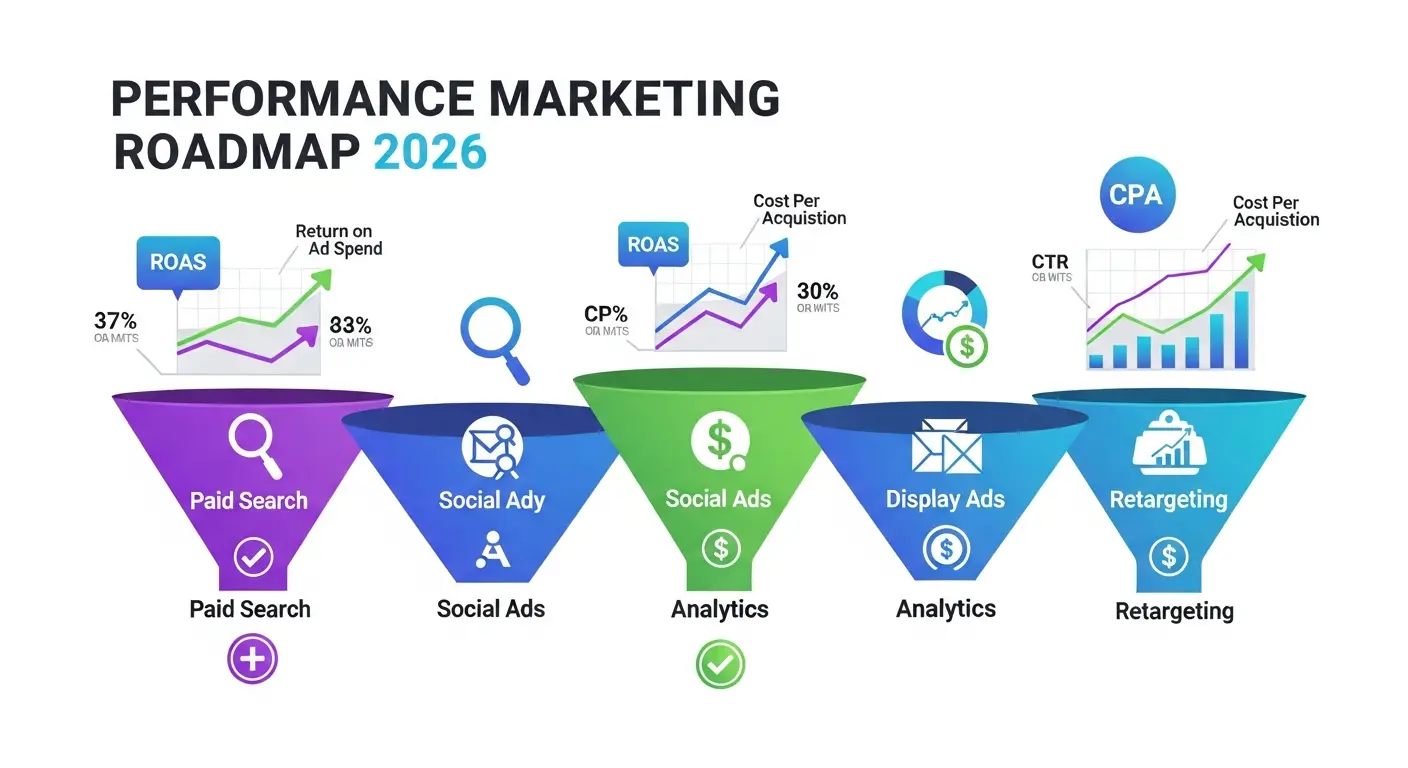
The global digital advertising and marketing market reached $740.3 billion in 2024 and is projected to hit $854.9 billion by 2026. Within this landscape, performance marketing stands out as the discipline that ties every marketing dollar directly to measurable results. With PPC advertising generating an average 200% ROI and companies using AI in marketing reporting 41% revenue increases, performance marketing skills have never been more valuable.
This performance marketing roadmap provides a structured path from foundational concepts to advanced optimization strategies. You’ll learn to build campaigns that deliver measurable results across paid search, social advertising, display, and emerging channels while developing the analytical mindset that separates top performers from the rest.
What Is Performance Marketing?
Performance marketing is a results-driven approach where advertisers pay only when specific actions occur: clicks, leads, sales, or other measurable outcomes. Unlike traditional brand advertising where you pay for exposure, performance marketing creates direct accountability between spending and results.
The core principle is simple: every dollar spent must be traceable to a measurable outcome. This requires sophisticated tracking, attribution modeling, and continuous optimization based on data rather than intuition.
Performance marketing encompasses:
- Paid Search (SEM/PPC): Google Ads, Microsoft Ads campaigns optimized for conversions
- Paid Social: Meta Ads, LinkedIn Ads, TikTok Ads with direct response objectives
- Display and Programmatic: Banner ads, native advertising, and real-time bidding
- Affiliate Marketing: Commission-based partnerships driving sales or leads
- Retargeting: Re-engaging users who previously interacted with your brand
- Influencer Marketing: Creator partnerships with trackable performance metrics
What distinguishes performance marketing from other digital marketing is the payment model and measurement focus. Performance marketers obsess over metrics like Cost Per Acquisition (CPA), Return on Ad Spend (ROAS), and Customer Lifetime Value (LTV) rather than impressions or reach alone.
Why Learn Performance Marketing in 2026?
The data presents a compelling case for developing performance marketing expertise.
Measurable ROI drives budget allocation. With 72% of overall marketing budgets going toward digital channels and 84% of brands reporting good results with PPC campaigns, performance marketing receives significant investment. For B2B brands, the top ROI-driving channels in 2024 were website/SEO, paid social, and social shopping tools. For B2C, email marketing, paid social, and content marketing led the way.
AI is amplifying results. Organizations implementing AI in marketing report an average 41% increase in revenue and 32% reduction in customer acquisition costs. Companies using AI see 22% higher ROI, 47% better click-through rates, and campaigns that launch 75% faster than those built manually. Performance marketers who master AI tools gain significant competitive advantage.
Conversion rates are improving. According to 2025 benchmarks, 65% of industries saw better conversion rates, with the average Google Ads conversion rate at 6.96%. Smart strategy now beats cheap clicks: costs are rising, but so is performance for those who optimize effectively.
The field continues growing. Digital marketing is considered the fastest-growing in-demand job skill for 2025, with marketing job demand set to increase by 10% by 2026. Customer marketing managers and search marketing managers are both in lists of the fastest-growing jobs in the US.
Performance Marketing Salary Guide (USA 2025)
| Role | Average Salary | Range |
|---|---|---|
| Performance Marketing Analyst | $72,698 | $55,000 – $90,000 |
| Performance Marketing Specialist | $69,576 | $52,000 – $88,000 |
| Performance Marketing Associate | $69,311 | $50,000 – $85,000 |
| Performance Marketing Manager | $107,880 | $79,970 – $145,034 |
| Director of Performance Marketing | $166,880 | $130,000 – $200,000 |
| Head of Performance Marketing | $304,159 | $247,759 – $352,451 |
Salaries vary significantly by location. California leads with performance marketing managers earning $137,222 on average, followed by Massachusetts at $135,393 and Washington D.C. at $137,745. Experience, industry, and company size also significantly impact compensation.
Complete Performance Marketing Roadmap: 8 Phases
Phase 1: Master Performance Marketing Fundamentals (Week 1-3)
Before launching campaigns, build a strong foundation in the metrics, models, and mindset that drive performance marketing success.
Essential metrics to master:
- CPA (Cost Per Acquisition): Total cost to acquire one customer or lead. The average CPA on Google Ads is $48.96 for search.
- ROAS (Return on Ad Spend): Revenue generated per dollar spent on advertising. A 200% ROAS means $2 revenue for every $1 spent.
- LTV (Lifetime Value): Total revenue a customer generates over their relationship with your business. Critical for determining acceptable CPA.
- CAC (Customer Acquisition Cost): Full cost to acquire a customer, including marketing, sales, and overhead.
- CTR (Click-Through Rate): Percentage of impressions resulting in clicks. Average for Google search is 6.42%.
- Conversion Rate: Percentage of clicks or visitors completing desired actions. Average across e-commerce is under 2%, while Google Ads averages 6.96%.
Understanding the performance marketing funnel:
Performance marketing focuses primarily on the action stages of the funnel, consideration and purchase, where conversions lead to measurable revenue. While top-of-funnel awareness matters, performance marketers prioritize campaigns that drive direct response.
Learn the relationship between LTV and CAC. A healthy ratio is typically 3:1 or higher, meaning a customer’s lifetime value should be at least three times the cost to acquire them. This ratio determines how aggressively you can bid for conversions.
Attribution fundamentals:
Understand how credit is assigned to different touchpoints. Last-click attribution gives all credit to the final interaction, while multi-touch models distribute credit across the journey. The marketing attribution software market is projected to grow from $5.34 billion in 2025 to $10.10 billion by 2030, reflecting the growing importance of accurate attribution.
Phase 2: Master Paid Search Advertising (Week 4-10)
Paid search remains the highest-performing digital channel for intent-driven conversions. With 76% of small businesses satisfied with search advertising and nearly half planning to increase investment, search ads are foundational to performance marketing.
Google Ads mastery:
Google Ads captures 39.37% of the global PPC market, with over 7 million businesses using it as their primary advertising platform. Focus on search campaigns first, since they target users actively seeking solutions.
Key optimization areas:
- Keyword strategy: Balance broad match for reach with exact match for control. Build comprehensive negative keyword lists to eliminate waste.
- Quality Score optimization: Improve expected CTR, ad relevance, and landing page experience. Higher Quality Scores lower costs and improve positions.
- Bid strategy selection: Choose between manual CPC, Target CPA, Target ROAS, or Maximize Conversions based on goals and data volume.
- Ad copy testing: Continuously test headlines and descriptions. Focus on benefits, include keywords, and use strong calls-to-action.
2024-2025 search advertising benchmarks:
| Metric | Average | Best Performers |
|---|---|---|
| CTR | 6.42% | 13.04% (Arts & Entertainment) |
| CPC | $4.66 | $1.72 (Arts & Entertainment) |
| Conversion Rate | 6.96% | 12.96% (Automotive Repair) |
| Cost Per Lead | $66.69 | Varies by industry |
CPCs increased in 86% of industries in 2024, with a 10% average rise. However, conversion rates improved for 65% of industries, indicating that smart optimization overcomes rising costs.
Phase 3: Master Paid Social Advertising (Week 11-17)
Social media advertising offers sophisticated targeting based on demographics, behaviors, and interests. With global social media ad spending at $234 billion and 76% of PPC marketers running campaigns on Facebook, paid social is essential for performance marketers.
Platform selection by objective:
Meta Ads (Facebook/Instagram): With 3.35 billion daily users across Meta platforms, this is the largest paid social ecosystem. Meta’s sophisticated retargeting increases impressions and boosts brand loyalty. Average CTR for traffic campaigns is 1.57% with $0.77 average CPC.
LinkedIn Ads: Essential for B2B performance marketing. Brands observe 33% purchase intent increase after running targeted LinkedIn ads, and audiences are 6x more likely to convert when exposed to both brand and acquisition ads. Average CPC is $5.58, higher than other platforms but justified by lead quality.
TikTok Ads: One of the top paid channels for reaching Gen Z and younger Millennials. With 1.59 billion global users and 135 million in the US, TikTok offers high engagement. Focus on native-style creative that mirrors organic content.
Key paid social skills:
- Audience building: Create custom audiences from customer lists, website visitors, and app users. Build lookalike audiences to find new prospects similar to your best customers.
- Pixel implementation: Master Meta Pixel, LinkedIn Insight Tag, and TikTok Pixel for accurate conversion tracking and optimization.
- Creative testing: Social ads require constant creative refresh. Test video versus static, different hooks, and various formats to combat ad fatigue.
- Retargeting strategies: Re-engage users who visited your site, watched videos, or engaged with content. Retargeting software market expected to reach $8.8 billion by 2029.
Phase 4: Develop Analytics and Tracking Expertise (Week 18-24)
Data is the foundation of performance marketing. Without accurate tracking and attribution, optimization is impossible.
Google Analytics 4 mastery:
GA4’s event-based model replaces session-based tracking, requiring a new approach to measurement. Learn to configure conversions, build audiences, and connect GA4 data to advertising platforms. GA4 integrates seamlessly with Google Ads for enhanced conversion tracking and optimization.
Attribution modeling:
Understand different attribution models and their implications:
- Last-click: All credit to final touchpoint. Simple but ignores the full journey.
- First-click: All credit to initial touchpoint. Useful for understanding awareness channels.
- Linear: Equal credit across all touchpoints. Fair but doesn’t account for varying influence.
- Time-decay: More credit to touchpoints closer to conversion. Reflects recency importance.
- Data-driven: Algorithm determines credit based on actual contribution. Requires sufficient data.
The marketing attribution software market’s growth to $10.10 billion by 2030 reflects the critical importance of solving attribution challenges in a multi-channel environment.
Conversion tracking implementation:
Learn to implement tracking across platforms: Google Ads conversion tracking, Meta Conversions API (CAPI), offline conversion imports, and call tracking. Server-side tracking is increasingly important as browser restrictions limit cookie-based tracking.
Building dashboards:
Create dashboards that surface actionable insights. Focus on metrics that drive decisions rather than vanity metrics. Integrate data from multiple platforms for a unified view of performance.
Phase 5: Master Programmatic and Display Advertising (Week 25-30)
Programmatic advertising reached $595 billion globally in 2024 and is projected to approach $800 billion by 2028. In the US, 88.2% of display ads are purchased programmatically.
Programmatic fundamentals:
Understand the programmatic ecosystem: Demand-Side Platforms (DSPs) allow advertisers to buy inventory, Supply-Side Platforms (SSPs) enable publishers to sell, and ad exchanges facilitate real-time transactions.
Real-Time Bidding (RTB): When users visit websites, auctions occur in milliseconds. Your DSP bids on impressions based on targeting criteria and bid parameters. Learn bid strategies, frequency capping, and viewability optimization.
Key programmatic channels:
Display advertising: Average CPC for display is $0.63, significantly lower than search. Effective for awareness and retargeting. Modern display uses machine learning for hyper-personalized content based on user behavior.
Connected TV (CTV): CTV ad spending grew 25% in 2024, with programmatic CTV providing accurate measurement and audience segmentation. Netflix expanded programmatic partnerships to include The Trade Desk, Magnite, and DV360 in 2024.
Digital Out-of-Home (DOOH): DOOH is rapidly growing with advances in measurement and targeting. Programmatic buying increases, moving away from direct deals with high minimums toward agile, flexible campaigns.
Performance-focused programmatic strategies:
Focus on viewability: track whether ads are actually seen, not just served. Implement strict brand safety filters. Use cross-device measurement to connect programmatic views to actions on other devices.
Phase 6: Develop Conversion Rate Optimization Skills (Week 31-35)
Driving traffic is only half the equation. Converting that traffic determines ROI.
Landing page optimization:
Companies with 30+ landing pages generate 7 times more leads than those with fewer than 10. The average landing page conversion rate is 2.35% across industries, but top performers achieve significantly higher. Long landing pages can generate up to 220% more leads than above-the-fold CTAs alone.
Key CRO elements:
- Headline testing: Your headline is the first thing visitors see. Test benefit-focused headlines against feature-focused alternatives.
- Call-to-action optimization: Dynamic CTAs convert 202% better than static ones. Test button text, color, placement, and size.
- Form optimization: Reduce friction by minimizing fields. Test multi-step forms against single-page forms.
- Social proof: Add testimonials, reviews, and trust signals. Video content on landing pages increases conversion rates by 38.6% according to marketers.
A/B testing discipline:
Regularly running A/B tests on emails improves ROI by an average of 82%. Apply this discipline across landing pages, ad creative, and user flows. Even small changes can impact conversion rates by as much as 300%.
Speed and mobile optimization:
An estimated 73% of e-commerce sales will be made via mobile devices in 2025. Ensure landing pages load quickly and provide seamless mobile experiences. Mobile devices generate over 60% of global web traffic.
Phase 7: Build Multi-Channel and Omnichannel Strategies (Week 36-40)
The most effective performance marketing happens when channels work together rather than in silos.
Full-funnel approach:
Enterprise companies allocated up to 79% of spend to top-of-funnel efforts in 2024, focusing on brand building and reach. However, performance marketers must balance awareness with direct response. Use programmatic display and video for awareness, search and retargeting for consideration, and optimized landing pages for conversion.
Channel integration strategies:
- Promote top-performing organic content with paid amplification
- Use paid search for high-value keywords difficult to rank organically
- Run retargeting campaigns on organic traffic to improve conversion
- Apply paid insights (audiences, messaging) to inform organic content
Cross-channel attribution:
Customer journeys are non-linear. Someone might discover your brand on Instagram, read reviews on Google, click a retargeting ad, and convert through an abandoned cart email. Cross-channel attribution tools integrate performance across multiple platforms for accurate ROI assessment.
Budget allocation optimization:
Use data to shift budget toward highest-performing channels and campaigns. Marketing mix modeling (MMM) combined with multi-touch attribution provides the most accurate view of channel effectiveness. Google Search remained the highest-performing digital channel in 2024 for intent-driven conversions.
Phase 8: Master AI and Automation (Week 41-44)
AI is transforming performance marketing. In 2025, global AI spend for sales and marketing reached $57.99 billion, projected to rise to $144 billion by 2030.
AI-powered campaign optimization:
Most ad platforms now offer AI-powered optimization, from bidding to creative testing. Google’s Performance Max and Meta’s Advantage+ use AI to optimize across placements automatically. Learn when to trust automation and when to override it.
AI applications in performance marketing:
- Predictive analytics: Anticipate trends, forecast user behavior, and optimize campaigns proactively
- Creative generation: Generate ad copy and visuals at scale, with human curation refining outputs
- Bid management: Real-time bid adjustments based on conversion probability
- Audience optimization: AI-driven audience expansion and suppression
First-party data strategies:
With third-party cookies fading, brands are doubling down on first-party data. Build customer data platforms (CDPs) that enable precise targeting without relying on deprecated tracking methods. 97% of businesses using CDPs report positive results in terms of revenues and customer loyalty.
Automation best practices:
Creative automation ensures consistent messaging across channels while tailoring content to platform requirements. Automation streamlines campaign development and enables rapid adaptation to trends, but requires human oversight for strategic decisions and brand voice.
Essential Performance Marketing Tools
| Category | Tool | Starting Price | Best For |
|---|---|---|---|
| Paid Search | Google Ads | No minimum | Search, Display, YouTube |
| Paid Search | Microsoft Ads | No minimum | Bing, Yahoo, LinkedIn targeting |
| Paid Social | Meta Ads Manager | No minimum | Facebook, Instagram |
| Paid Social | LinkedIn Campaign Manager | $10/day minimum | B2B lead generation |
| Analytics | Google Analytics 4 | Free | Website analytics, attribution |
| Attribution | Triple Whale | $149-449/month | E-commerce attribution |
| Attribution | Ruler Analytics | Custom pricing | B2B lead attribution |
| CRO | Unbounce | $99/month | Landing page testing |
| CRO | Hotjar | Free-$99/month | Heatmaps, session recording |
| Reporting | Supermetrics | $39/month | Data aggregation |
| Automation | Optmyzr | $249/month | PPC automation |
| Call Tracking | CallRail | $50/month | Phone attribution |
Performance Marketing Certifications
| Certification | Provider | Cost | Duration | Key Topics |
|---|---|---|---|---|
| Google Ads Search | Google Skillshop | Free | 4-6 hours | Search campaigns, optimization |
| Google Ads Display | Google Skillshop | Free | 3-5 hours | Display network, targeting |
| Google Ads Measurement | Google Skillshop | Free | 4-6 hours | Conversion tracking, attribution |
| Meta Digital Marketing Associate | Meta Blueprint | $99-150 | Self-paced | Meta Ads, measurement |
| Microsoft Advertising Certified | Microsoft | Free | Self-paced | Microsoft Ads platform |
| Google Analytics 4 | Google Skillshop | Free | 4-6 hours | GA4 implementation, analysis |
Google certifications are free and widely recognized. Complete multiple certifications to demonstrate comprehensive platform expertise. Meta certifications require exam fees but carry significant weight for roles involving Meta advertising.
Career Paths in Performance Marketing
Entry-level roles (0-2 years): Performance Marketing Analyst, Paid Media Coordinator, Digital Advertising Specialist, PPC Analyst
Mid-level roles (2-5 years): Performance Marketing Manager, Paid Media Manager, Growth Marketing Manager, Acquisition Manager
Senior roles (5+ years): Director of Performance Marketing, Head of Paid Media, VP of Growth, Head of Performance Marketing
Specialization paths:
Some performance marketers specialize by channel (paid search specialist, programmatic specialist) while others specialize by industry or business model (e-commerce, lead generation, SaaS). Both paths offer strong career trajectories.
Agency vs. in-house:
Agency roles provide exposure to multiple clients, industries, and budget levels, building broad experience quickly. In-house roles allow deeper integration with business strategy and longer-term optimization. Many professionals move between both throughout their careers.
Complementary skills:
Strong performance marketers develop skills in analytics for deeper data analysis, conversion rate optimization for landing page improvement, and content creation for compelling ad creative.
Frequently Asked Questions
What’s the difference between performance marketing and digital marketing?
Digital marketing encompasses all marketing activities using digital channels, including brand awareness, content marketing, and organic social media. Performance marketing is a subset specifically focused on measurable, trackable outcomes where advertisers pay for specific actions like clicks, leads, or sales. All performance marketing is digital marketing, but not all digital marketing is performance marketing.
How long does it take to become a performance marketer?
Learning fundamentals takes 3-6 months with dedicated study and hands-on practice. Becoming proficient (able to manage significant budgets and deliver consistent results) typically requires 1-2 years of experience. The field evolves rapidly, so continuous learning is essential throughout your career.
What budget is needed to practice performance marketing?
You can start learning with $5-10 per day on platforms like Google Ads or Meta Ads, which have no minimum spend requirements. Focus on search campaigns initially for clearer cause-and-effect learning. Many practitioners recommend $300-500 per month while developing skills.
Is performance marketing better for B2B or B2C?
Performance marketing works for both, but tactics differ. B2C typically sees faster conversion cycles and can leverage platforms like Meta and TikTok effectively. B2B often requires LinkedIn advertising, longer nurture sequences, and measurement of offline conversions. The top ROI channels differ: B2B favors website/SEO and paid social, while B2C sees best results from email marketing and paid social.
How do I prove ROI to stakeholders?
Use attribution tools that connect marketing activities to revenue, not just leads. Build dashboards showing CPA, ROAS, and LTV metrics alongside spend. Implement proper conversion tracking across the entire funnel. Conduct incrementality tests to prove that your marketing drives results that wouldn’t happen otherwise.
What’s the most important performance marketing skill?
Analytical thinking and data interpretation matter most. Platform knowledge becomes outdated as interfaces change, but the ability to extract insights from data, form hypotheses, and test systematically remains valuable regardless of platform evolution.
Key Takeaways
- Global digital advertising market reached $740.3 billion in 2024, projected to hit $854.9 billion by 2026
- PPC advertising generates average 200% ROI: $2 for every $1 spent
- AI-driven marketing campaigns see 22% higher ROI and 47% better CTRs
- Average Performance Marketing Manager salary is $107,880, with senior roles exceeding $300,000
- 65% of industries saw improved conversion rates in 2024-2025
- 88.2% of US display ads are purchased programmatically
- Marketing attribution software market growing to $10.10 billion by 2030
- Organizations using AI in marketing report 41% revenue increase
Your Next Steps
Start by earning Google Ads Search and Google Analytics 4 certifications through Skillshop, both free and demonstrating foundational knowledge. Set up practice campaigns with small budgets to learn platform interfaces and optimization techniques.
Build your portfolio by managing campaigns for a small business, nonprofit, or personal project. Document results meticulously, including what worked, what didn’t, and what you learned.
Develop your analytical skills alongside platform knowledge. Learn to use spreadsheets for data analysis, understand statistical significance in testing, and build dashboards that surface actionable insights.