
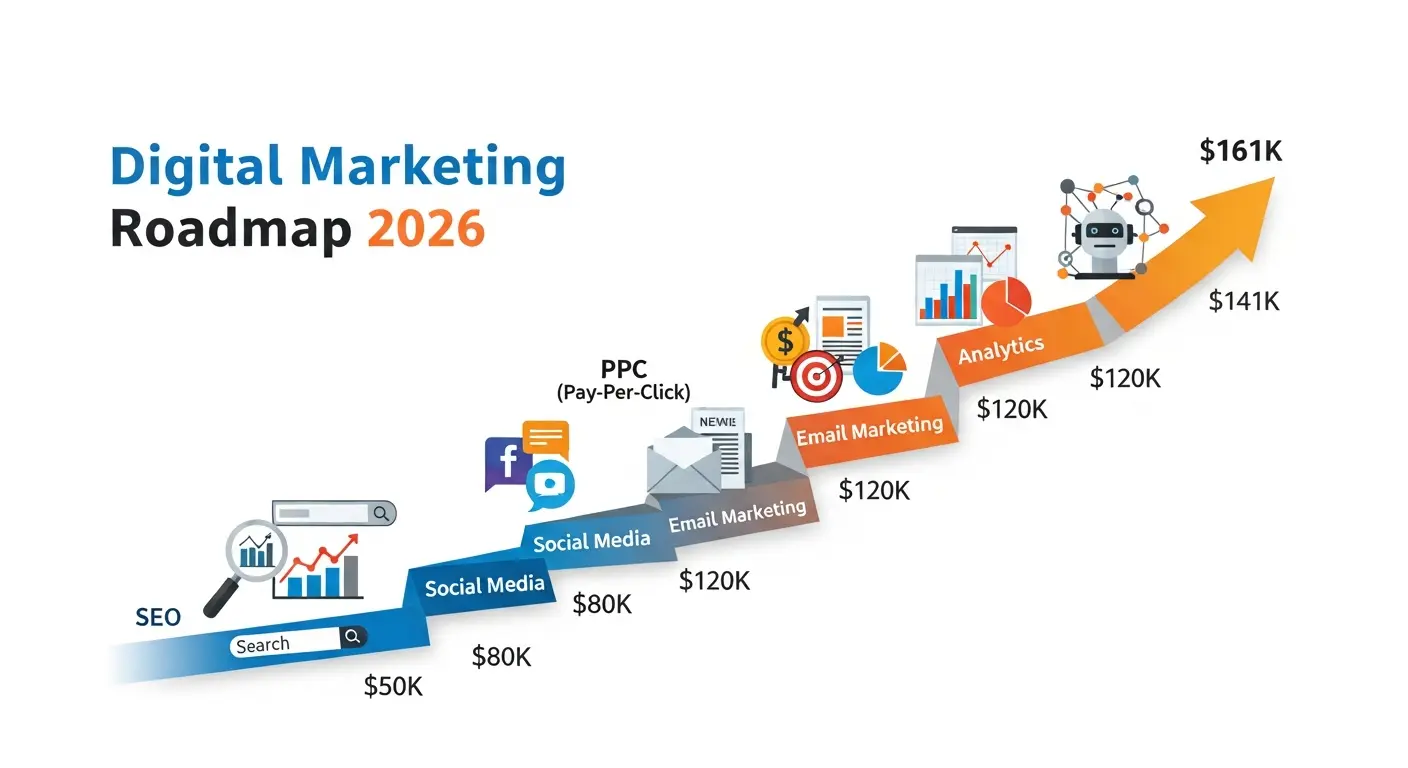
Digital marketing offers one of the most accessible paths to a six-figure career in 2026. With median marketing manager salaries reaching $161,030 and 36,400 new job openings projected annually through 2034, the opportunity has never been stronger.
This digital marketing roadmap provides a clear, data-backed path from complete beginner to in-demand professional. You’ll learn exactly what skills to master, which tools to use, and how to position yourself for maximum earning potential in the U.S. market.
What Is Digital Marketing?
Digital marketing is the practice of promoting products, services, or brands through online channels including search engines, social media platforms, email, websites, and mobile applications.
Unlike traditional marketing, digital marketing enables precise audience targeting, real-time performance tracking, and measurable ROI on every dollar spent. The U.S. digital advertising market reached $258.6 billion in 2024, representing 72.7% of all advertising spending.
Core digital marketing channels include: Search Engine Optimization (SEO), Pay-Per-Click Advertising (PPC), Social Media Marketing, Content Marketing, Email Marketing, Affiliate Marketing, and Marketing Analytics.
Why Learn Digital Marketing in 2026?
The data strongly supports digital marketing as a career choice for 2026 and beyond.
Job growth exceeds national averages. The Bureau of Labor Statistics projects 6-7% growth for marketing managers through 2034, double the 3% average across all occupations. Current employment stands at 407,000 marketing manager positions, with 36,400 annual openings from expansion and turnover.
Salaries reward specialization. Entry-level positions start between $40,000-$65,000, while mid-level managers earn $70,000-$130,000. Senior specialists and managers regularly exceed $160,000, with the top 10% earning above $239,200 annually.
AI skills command premium pay. Marketers proficient in AI tools now earn a 43% wage premium over peers, up from 25% in 2024. With 88% of marketers using AI daily, these skills have become essential rather than optional.
Remote work remains prevalent. Marketing offers exceptional flexibility with 30% hybrid and 15% fully remote positions, making it ideal for those seeking work-life balance.
Digital Marketing Salary by Role (USA 2025)
| Role | Entry-Level | Mid-Level | Senior-Level |
|---|---|---|---|
| Digital Marketing Manager | $50,000 | $85,000 | $161,030 |
| SEO Specialist | $34,500 | $67,388 | $104,500 |
| PPC/Paid Search Specialist | $46,950 | $82,187 | $107,000 |
| Social Media Manager | $42,000 | $71,408 | $135,000 |
| Content Marketing Manager | $48,000 | $111,196 | $143,000 |
| Email Marketing Specialist | $45,000 | $72,172 | $111,000 |
Geographic location significantly impacts compensation. New York City offers a 12% premium over national averages, San Francisco adds 13%, while cities like Dallas and Austin provide strong salaries with lower cost of living.
Complete Digital Marketing Roadmap: 8 Phases
Phase 1: Master Marketing Fundamentals (Weeks 1-2)
Before diving into tools and tactics, understand core marketing principles. Learn customer psychology, the marketing funnel (awareness, consideration, decision), buyer personas, and value propositions.
Study the difference between B2B and B2C marketing approaches. Analyze how successful brands position themselves and communicate with audiences across different channels.
Action step: Analyze 5 brands you admire and document their messaging, target audience, and channel mix.
Phase 2: Build Your Digital Presence (Weeks 3-4)
Create your personal brand before marketing for others. This becomes your portfolio and testing ground for every skill you learn.
Set up a WordPress website or blog focused on a topic you’re passionate about. Create professional profiles on LinkedIn, Twitter, and Instagram. Begin documenting your learning journey publicly to build credibility.
Action step: Launch a simple blog and publish your first post within 7 days.
Phase 3: Master SEO Fundamentals (Weeks 5-8)
Search Engine Optimization remains foundational to digital marketing success. Organic search drives 53% of average website traffic and 52.7% of B2B revenue. A solid SEO roadmap positions you for long-term organic growth.
Learn keyword research using tools like Ubersuggest, Ahrefs, or SEMrush. Understand on-page optimization including title tags, meta descriptions, header structure, and internal linking. Study technical SEO basics like site speed, mobile optimization, and crawlability.
Key concepts to master: Search intent, long-tail keywords, backlink building, local SEO, Google Search Console, and AI Overviews optimization.
Phase 4: Develop Content Marketing Skills (Weeks 9-12)
Content fuels every digital marketing channel. Whether blog posts, videos, podcasts, or social media, content drives engagement and conversions.
Study different content formats and when to use each. Learn copywriting fundamentals including headlines, hooks, and calls-to-action. Understand content calendars and editorial planning for consistent publishing.
Practice writing blog posts, social captions, email sequences, and ad copy. AI tools like ChatGPT and Jasper can accelerate content creation, but human strategy and editing remain essential.
Action step: Publish 10 blog posts on your website, focusing on solving specific problems for your target audience.
Phase 5: Dominate Social Media Marketing (Weeks 13-16)
Social media advertising generated $88.8 billion in 2024, growing 36.7% year-over-year. Master social media marketing to build communities and drive measurable results.
Learn platform-specific strategies for LinkedIn (best for B2B with 40% of marketers finding it most effective for leads), Instagram (ad revenue projected at $71 billion in 2025), TikTok (2.5-7.5% organic engagement rates), and Facebook (3.065 billion monthly users).
Study both organic growth tactics and paid social advertising. Learn to read platform analytics and adjust strategies based on performance data.
Platforms to prioritize: LinkedIn for B2B, Instagram and TikTok for B2C, YouTube for long-form content.
Phase 6: Learn Paid Advertising (Weeks 17-20)
Organic growth takes time. Paid advertising delivers immediate, scalable results. Understanding media buying, SEM, and PPC is essential for performance marketing roles.
Start with Google Ads, which commands $102.9 billion in annual spending. Learn search campaigns, display advertising, and YouTube video ads. Move to Meta Ads (Facebook and Instagram) for social advertising mastery.
Understand campaign objectives, audience targeting, bidding strategies, and conversion tracking. Google Ads returns $2 for every $1 spent on average, making PPC skills highly valuable.
Key metrics to track: CPC (Cost Per Click), CPM (Cost Per Mille), CTR (Click-Through Rate), ROAS (Return on Ad Spend), and CPA (Cost Per Acquisition).
Phase 7: Master Email Marketing (Weeks 21-24)
Email marketing delivers the highest ROI of any channel at $36-42 for every $1 spent. A strong email marketing strategy converts subscribers into loyal customers.
Learn email list building, segmentation, and personalization. Study email copywriting, subject line optimization, and A/B testing methodologies. Master automation platforms like Mailchimp, Klaviyo, or ActiveCampaign.
Current benchmarks show average open rates of 42-43% and click-through rates of 2.0-2.6%. Welcome emails achieve 83.63% open rates, while automated sequences drive 37% of email-generated sales despite comprising only 2% of volume.
Action step: Build an email list of 100 subscribers and create a 5-email welcome sequence.
Phase 8: Analytics and AI Integration (Weeks 25-28)
Data drives every marketing decision. Without analytics skills, you cannot optimize campaigns or demonstrate ROI to clients and employers.
Master Google Analytics 4 (GA4) for website tracking and Google Tag Manager for event tracking. Learn attribution models, conversion paths, and reporting dashboards using tools like Looker Studio.
Integrate AI tools into your workflow. Content creation time decreases by 5+ hours weekly with AI assistance, while campaign launch speeds improve 75%. Learn prompt engineering for ChatGPT, Jasper, and specialized marketing AI tools.
Essential analytics tools: Google Analytics 4 (free), Google Search Console (free), Hotjar ($39-213/month), and Mixpanel (free tier available).
Digital Marketing Tools Comparison
| Category | Tool | Starting Price | Best For |
|---|---|---|---|
| SEO | Ubersuggest | $12/month | Beginners |
| SEO | Ahrefs | $29/month | Link building |
| SEO | SEMrush | $139.95/month | All-in-one |
| Mailchimp | Free (500 contacts) | Small lists | |
| Klaviyo | Free (250 profiles) | E-commerce | |
| ActiveCampaign | $15/month | Automation | |
| Social | Buffer | $5/channel/month | Budget-friendly |
| Social | Hootsuite | $99/month | Enterprise |
| Analytics | Google Analytics 4 | Free | Website tracking |
| AI Content | ChatGPT Plus | $20/month | Content creation |
| AI SEO | Surfer SEO | $99/month | Content optimization |
Top Certifications for Digital Marketers
Certifications provide measurable career advantages. DMI alumni report 74% achieving salary increases averaging $12,000, while certified marketing managers earn approximately $34,000 more than uncertified peers.
Free certifications to prioritize:
Google Analytics 4 Certification, Google Ads Certifications (Search, Display, Video), HubSpot Inbound Marketing (4 hours), HubSpot Content Marketing (7 hours), SEMrush SEO Toolkit Certification, and Meta Digital Marketing Associate preparation materials.
Paid certifications worth the investment:
Google Digital Marketing & E-commerce Certificate via Coursera ($49/month, 6 months) connects graduates with 150+ hiring companies including Deloitte and Target. Meta Digital Marketing Associate ($99 exam) validates social advertising expertise. Hootsuite Social Marketing Certification ($199) offers lifetime validity with no renewal required.
Career Opportunities and Growth Path
Digital marketing offers diverse career paths with clear advancement opportunities.
Entry-level roles (0-2 years): Digital Marketing Coordinator, SEO Specialist, Social Media Coordinator, Content Writer, Email Marketing Assistant. Expected salary: $40,000-$65,000.
Mid-level roles (3-5 years): Digital Marketing Manager, PPC Manager, Content Marketing Manager, Social Media Manager. Expected salary: $70,000-$130,000.
Senior roles (6+ years): Director of Digital Marketing, VP of Marketing, Chief Marketing Officer, Head of Growth. Expected salary: $130,000-$239,000+.
Freelance potential: Independent digital marketers earn $50-150 per hour depending on specialization. Monthly retainers range from $1,000-$2,000 for basic packages to $4,000-$6,000 for enterprise clients. Annual freelance earnings average $78,000 nationally.
The strongest job markets include New York City (20,000+ openings), Los Angeles (12,500+ openings), San Francisco (strong analytics focus), Dallas (22 Fortune 500 headquarters), and Seattle (Amazon and Microsoft ecosystem).
Frequently Asked Questions
How long does it take to learn digital marketing?
With consistent daily practice of 2-3 hours, you can grasp fundamentals in 3-4 months. Becoming job-ready typically takes 6-8 months. Mastery requires 2-3 years of hands-on experience across multiple campaigns, industries, and budget levels.
Can I learn digital marketing without a degree?
Yes. Digital marketing is skill-based, not degree-based. Employers prioritize portfolios, certifications, and demonstrated results over formal education. Many successful digital marketers are self-taught through online courses and hands-on practice.
Which digital marketing skill pays the most?
PPC and performance marketing specialists command premium salaries due to direct revenue impact. Senior PPC managers earn $82,000-$107,000, while performance marketing directors can exceed $150,000. AI-skilled marketers across all specializations earn a 43% wage premium.
Is digital marketing a good career in 2026?
Digital marketing remains one of the strongest career paths available. With 6-7% job growth (double national average), 36,400 annual openings, median salaries of $161,030 for managers, and unemployment rates of just 2.4-3.1%, the field offers exceptional stability and growth potential.
How much can a beginner earn in digital marketing?
Entry-level digital marketers in the USA typically earn $40,000-$65,000 annually in full-time roles. Freelancers can earn $2,000-$5,000 monthly with 2-3 clients. Earnings grow significantly with specialization, certifications, and proven campaign results.
What’s the difference between digital marketing and performance marketing?
Digital marketing encompasses all online marketing activities. Performance marketing specifically focuses on campaigns where advertisers pay only for measurable results like clicks, leads, or sales. Performance marketing is a results-focused subset emphasizing direct ROI accountability.
Key Takeaways
- Digital marketing manager median salary reaches $161,030 with top earners exceeding $239,200
- 36,400 annual job openings projected through 2034 with 6-7% growth rate
- AI-skilled marketers earn 43% wage premium over non-AI-proficient peers
- Email marketing delivers highest ROI at $36-42 per $1 spent
- Free certifications from Google, HubSpot, and SEMrush provide immediate credibility
- Entry to job-ready takes 6-8 months with consistent 2-3 hours daily practice
- Top cities for jobs: NYC, LA, San Francisco, Dallas, Seattle
Your Next Steps
Digital marketing rewards action over perfection. Start Phase 1 today, launch your website this week, and publish your first content within 14 days.
Consider specializing once you understand the fundamentals. Some marketers focus deeply on SEO, others master email marketing, and some build expertise in affiliate marketing for passive income streams. The inbound marketing approach combines multiple channels for comprehensive customer acquisition.
The digital marketing industry will continue evolving with AI integration, but core principles remain constant: understand your audience, deliver value, measure results, and optimize continuously.
Your $161K career starts now.