
A significant 68% of all online activities start with a search engine, and the top organic result on Google captures 27.6% of all clicks. With organic search driving over 53% of all website traffic, SEO remains the most effective channel for building sustainable online visibility. The SEO market is estimated at $72.31 billion in 2025 and projected to reach $106.15 billion by 2030.
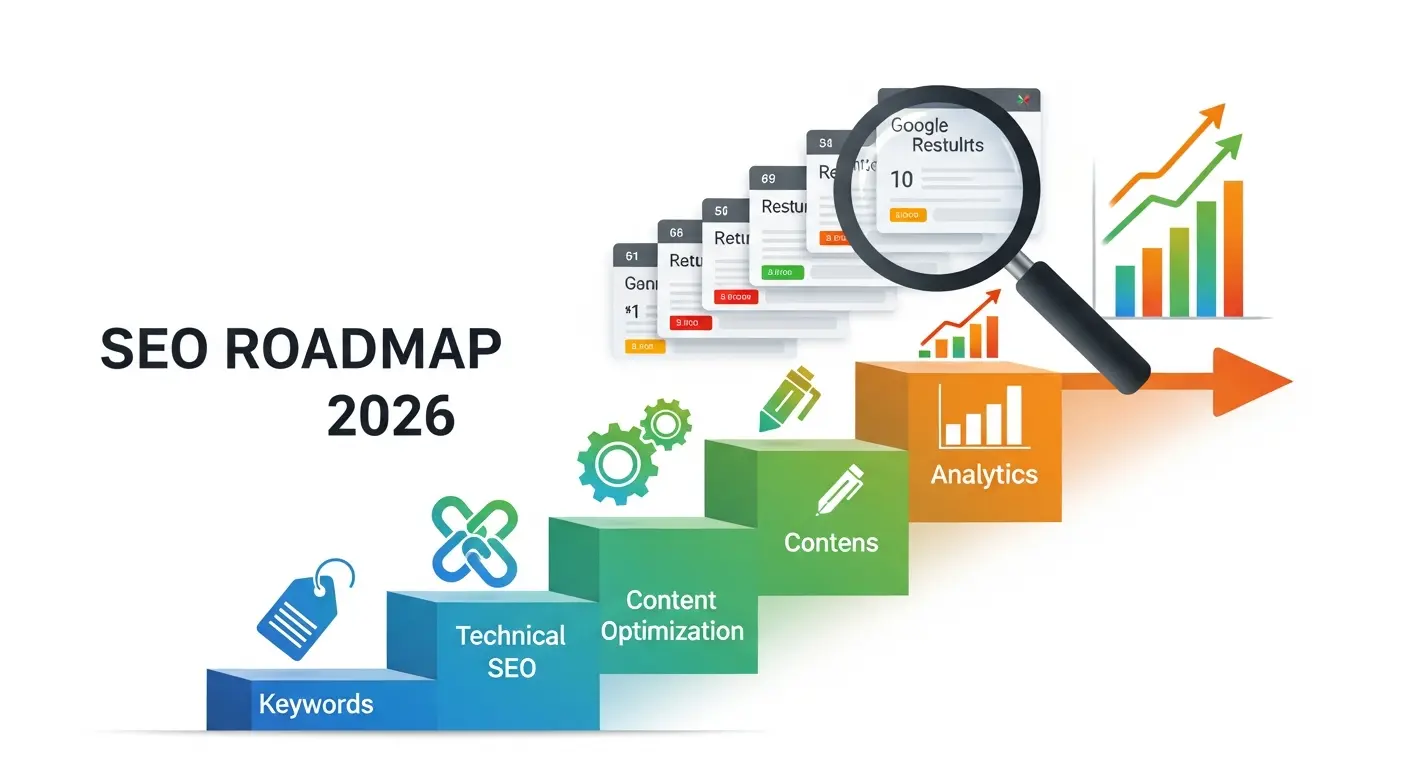
This SEO roadmap provides a structured path from fundamental concepts to advanced optimization strategies. You’ll learn how search engines work, master keyword research and on-page optimization, build authoritative backlinks, and develop the technical skills that drive rankings—all while adapting to the AI-powered search landscape of 2026.
What Is SEO?
Search Engine Optimization (SEO) is the practice of optimizing websites and content to rank higher in organic (non-paid) search engine results. When someone searches for information, products, or services on Google, Bing, or other search engines, SEO determines which websites appear in those results and in what order.
SEO encompasses three primary disciplines:
On-Page SEO involves optimizing individual web pages to rank higher. This includes content quality, keyword usage, title tags, meta descriptions, header structure, internal linking, and user experience signals.
Off-Page SEO focuses on building authority through external signals, primarily backlinks from other websites. Quality backlinks from authoritative sources tell search engines that your content is trustworthy and valuable.
Technical SEO addresses the technical aspects that help search engines crawl, index, and render your website effectively. This includes site speed, mobile-friendliness, crawlability, structured data, and security.
Google’s search algorithm considers over 200 ranking signals to determine which pages appear for any given search query. In 2025, the most influential ranking factors are content quality, backlinks, and alignment with search intent.
Why Learn SEO in 2026?
The data makes a compelling case for developing SEO expertise.
Organic search dominates traffic. Over 53% of all website traffic comes from organic search, making SEO the top driver of web traffic. Across multiple industries, over 40% of revenue is driven by organic traffic. Google processes 16.4 billion searches every day—roughly 190,000 searches every second.
ROI exceeds other channels. SEO delivers an 8x ROI, double the 4x return of PPC, based on data from 119 companies. SEO leads close at 14.6% compared to just 1.7% for outbound leads—making SEO leads 8.5 times more likely to convert. Companies that implement SEO strategies save up to 400% on ad spending without affecting the attraction of their target audience.
Rankings matter significantly. The first page of search results captures more than 99% of all clicks. Only 0.63% of users click on anything from the second page of Google. Climbing from position #2 to #1 leads to a 74.5% increase in clicks. Every time you move up a single spot on the SERP, you can expect a 32.3% CTR boost.
AI is changing but not replacing SEO. Google’s AI Overviews now appear for approximately 13% of queries. While some websites have experienced traffic declines, 63% of respondents reported that AI Overviews have positively impacted organic traffic, visibility, or rankings. Organizations with high SEO maturity are more than 3x as likely to report positive impacts from AI changes.
SEO Salary Guide (USA 2025)
| Role | Average Salary | Range |
|---|---|---|
| SEO Coordinator (Entry) | $50,000 | $40,000 – $62,000 |
| SEO Specialist | $67,388 – $85,368 | $53,000 – $113,859 |
| SEO Analyst | $72,000 | $55,000 – $90,000 |
| SEO Manager | $119,337 | $90,000 – $145,000 |
| Senior SEO Specialist | $100,111 | $80,000 – $130,000 |
| Director of SEO | $140,000 | $110,000 – $180,000 |
| Head of SEO | $165,000+ | $130,000 – $200,000+ |
SEO managers earn 41.5% more on average than specialists without leadership roles. The average salary of SEO professionals in the US is approximately $70,000-$86,000 per year, with top earners in senior roles exceeding $150,000. Entry-level specialists with up to 3 years experience average $64,488, mid-level (3-5 years) averages $85,380, and senior-level (5+ years) averages $113,868.
Complete SEO Roadmap: 8 Phases
Phase 1: Master SEO Fundamentals (Week 1-3)
Before optimizing anything, understand how search engines work and what drives rankings.
How search engines work:
Search engines perform three core functions: crawling (discovering content), indexing (storing and organizing content), and ranking (determining the order of results). Google’s crawlers follow links across the web, discovering new and updated pages. Indexed pages are evaluated against hundreds of ranking factors when a user performs a search.
Understanding search intent:
Search intent is the reason behind a query. The four main types are:
- Informational: User wants to learn something (“how to bake bread”)
- Navigational: User wants a specific website (“Facebook login”)
- Transactional: User wants to buy something (“buy running shoes online”)
- Commercial investigation: User researching before purchasing (“best laptops 2026”)
Matching your content to search intent is critical—Google prioritizes pages that best satisfy what users are actually looking for.
Key ranking factors:
Google’s algorithm considers over 200 signals, but in 2025 the most influential are content quality, backlinks, and alignment with search intent. Other significant factors include page experience (Core Web Vitals), mobile-friendliness, HTTPS security, and user engagement signals.
Essential SEO metrics:
- Organic Traffic: Visitors from non-paid search results
- Keyword Rankings: Your position in SERPs for target keywords
- Click-Through Rate (CTR): Percentage of impressions that result in clicks
- Domain Authority/Domain Rating: Overall site authority metrics
- Backlinks: Links from other websites to yours
- Core Web Vitals: Page experience metrics (LCP, INP, CLS)
Phase 2: Master Keyword Research (Week 4-8)
Keywords are the foundation of SEO strategy—they power visibility, shape rankings, and guide user intent.
Keyword research fundamentals:
A staggering 94.74% of all keywords receive fewer than 10 searches per month, while fewer than 0.001% exceed 100,000 monthly searches. Roughly 15% of daily Google queries are entirely new and have never been searched before. This means opportunity exists across the entire search landscape.
Types of keywords:
- Head terms: Short, high-volume keywords (1-2 words) with high competition
- Long-tail keywords: Longer, specific phrases (4+ words) with lower competition but higher intent. 34.71% of all Google searches are long-tail queries containing four or more words.
- Local keywords: Include geographic modifiers for local businesses
- Branded vs. non-branded: Queries including your brand name vs. generic terms
Keyword research process:
- Brainstorm seed keywords based on your business, products, and services
- Use keyword research tools to expand your list and find related terms
- Analyze search volume, keyword difficulty, and search intent
- Prioritize keywords based on business value, difficulty, and intent alignment
- Group keywords into topical clusters for content planning
Keyword metrics to evaluate:
- Search volume: Monthly searches for a keyword
- Keyword difficulty: How hard it will be to rank (0-100 scale)
- CPC: What advertisers pay per click (indicates commercial value)
- SERP features: What appears in results (featured snippets, PAA, local pack)
- Click potential: Estimated clicks considering zero-click searches
Including a keyword in your page URL can improve CTR by up to 45%. Titles with question-based keywords average 15.5% CTR compared to 16.3% for non-question titles.
Phase 3: Master On-Page SEO (Week 9-14)
On-page SEO involves optimizing individual pages to rank higher and earn more relevant traffic.
Title tag optimization:
Your title tag is the most important on-page element. It appears in search results and browser tabs. Best practices include placing your primary keyword near the beginning, keeping titles under 60 characters to avoid truncation, making titles compelling to encourage clicks, and including your brand name when appropriate.
Meta description optimization:
Meta descriptions don’t directly impact rankings but significantly affect CTR. Write compelling 150-160 character descriptions that include your target keyword, clearly communicate page value, and include a call-to-action. Note that Google rewrites between 60% and 70% of all meta descriptions, so focus on accuracy and relevance.
Header structure (H1-H6):
Use a clear heading hierarchy. Your H1 should include the primary keyword and match the page’s main topic. Blog posts with seven or fewer words in their H1 tag obtain 36% higher organic traffic than those with fourteen or more words. Use H2s for main sections and H3s for subsections.
Content optimization:
97% of top-ranking Google pages include at least one image. Pages featuring videos attract 157% more organic traffic than those without. Only 22% of pages currently ranking in the top 10 were created in the last 12 months—nearly 60% are three or more years old.
Key on-page elements:
- Use your target keyword in the first 100 words
- Include related keywords and semantic variations naturally
- Optimize images with descriptive alt text and compressed file sizes
- Create internal links to related content on your site
- Ensure content is comprehensive and satisfies search intent
- Format for readability with short paragraphs, bullet points, and clear sections
Phase 4: Develop Technical SEO Skills (Week 15-22)
Technical SEO ensures search engines can effectively crawl, index, and render your website.
Site speed optimization:
Page speed is a confirmed ranking factor. Core Web Vitals—Largest Contentful Paint (LCP), Interaction to Next Paint (INP), and Cumulative Layout Shift (CLS)—measure user experience. Optimize by compressing images, minimizing JavaScript, using caching, and implementing CDNs.
Mobile optimization:
Mobile now accounts for 63.31% of all web traffic. Google uses mobile-first indexing, meaning it primarily uses the mobile version of content for indexing and ranking. 72.6% of internet users will only use smartphones to access the web in 2025. Ensure your site is fully responsive and provides an excellent mobile experience.
Crawlability and indexation:
Ensure search engines can access and understand your content. Key elements include:
- Robots.txt: Controls which pages crawlers can access
- XML sitemaps: Help search engines discover all your pages
- Canonical tags: Prevent duplicate content issues
- Internal linking: Helps distribute page authority and aids crawling
- HTTPS: Security is a ranking factor; all sites should use SSL
Structured data (Schema markup):
Structured data helps search engines understand your content and can enable rich results. Implement schema for articles, products, local businesses, FAQs, and reviews. Pages with structured data can earn enhanced SERP features that improve visibility and CTR.
Core Web Vitals:
Google’s page experience signals include:
- LCP (Largest Contentful Paint): Main content should load within 2.5 seconds
- INP (Interaction to Next Paint): Pages should respond to interactions within 200ms
- CLS (Cumulative Layout Shift): Visual stability score should be under 0.1
Phase 5: Master Link Building (Week 23-30)
Backlinks remain one of the most influential ranking factors. 41% of marketers view link building as the most challenging aspect of SEO.
Why backlinks matter:
Links from authoritative, relevant websites signal to Google that your content is trustworthy and valuable. The quality of backlinks matters more than quantity. A few links from high-authority sites can outweigh hundreds of low-quality links.
Link building statistics:
At least 66.5% of all backlinks are broken, creating opportunities for link reclamation. An average backlink costs $361.44 when purchased through outreach or content services. On average, it takes 3.1 months to see the impact of a backlink on search rankings. 89.1% of link builders say that no-follow links still have an impact on rankings.
Effective link building strategies:
Content-driven link building: Create exceptional content that naturally earns links. Original research, comprehensive guides, infographics, and data-driven content attract backlinks organically.
Guest posting: Contribute valuable content to authoritative websites in your industry. Focus on quality over quantity and choose relevant, reputable sites.
Digital PR: Create newsworthy stories, data, or campaigns that journalists and bloggers want to cover. This can generate high-authority links from media outlets.
Broken link building: Find broken links on other websites, create content that matches the broken resource, and reach out to suggest your content as a replacement.
Resource link building: Create valuable resources (tools, templates, guides) that others want to link to and reference.
Link quality factors:
- Domain authority of the linking site
- Relevance of the linking page to your content
- Anchor text (the clickable text of the link)
- Link placement within the content
- Whether the link is followed or no-follow
Phase 6: Master Content Strategy (Week 31-36)
Content is the foundation of SEO success. Without valuable content, there’s nothing to rank.
Content quality signals:
Google’s E-E-A-T framework (Experience, Expertise, Authoritativeness, Trustworthiness) guides content quality assessment. Demonstrate real expertise, cite authoritative sources, and build trust through accurate, helpful content.
Content types that perform:
Search results with videos drive 157% more organic traffic than those without. Video content has a 41% higher CTR than text-only pages. Google includes video thumbnails in 26% of search results. Google’s “People also ask” feature now shows up for nearly 49% of searches, creating opportunities for FAQ content.
Topic clusters and pillar pages:
Organize content into topical clusters around pillar pages. A pillar page covers a broad topic comprehensively, while cluster content addresses specific subtopics and links back to the pillar. This structure demonstrates topical authority and improves internal linking.
Content optimization process:
- Research the top-ranking content for your target keyword
- Identify what makes those pages rank (comprehensiveness, format, depth)
- Create content that’s significantly better and more useful
- Optimize on-page elements (title, headers, meta description)
- Add internal links from relevant existing content
- Promote content to earn initial engagement and links
- Update content regularly to maintain freshness
Content freshness:
While evergreen content can rank for years, certain topics require regular updates. Monitor rankings and update content when positions decline or when information becomes outdated.
Phase 7: Master Local SEO (Week 37-40)
For businesses serving specific geographic areas, local SEO is essential.
Local SEO importance:
Nearly 70% of local search queries come from mobile devices. 76% of people who perform a local search on their smartphone visit a location within 24 hours, and 28% of those searches result in a purchase. Gen Z is turning to social media for local businesses—67% use Instagram and 62% use TikTok, with Google only third at 61%.
Google Business Profile optimization:
Claim and optimize your Google Business Profile (formerly Google My Business). Include accurate business information, choose appropriate categories, add high-quality photos, respond to reviews, and post regular updates. This is critical for appearing in local pack results and Google Maps.
Local ranking factors:
- Google Business Profile signals (completeness, accuracy, engagement)
- On-page signals (NAP consistency, local keywords, location pages)
- Review signals (quantity, quality, velocity, diversity)
- Link signals (local relevance, domain authority)
- Citation signals (NAP consistency across directories)
- Behavioral signals (click-through rate, mobile clicks to call)
Local citation building:
Ensure your business Name, Address, and Phone number (NAP) are consistent across all online directories, social profiles, and your website. Inconsistencies confuse search engines and hurt local rankings.
Phase 8: Analytics, Reporting, and Continuous Improvement (Week 41-44)
SEO success requires measurement, analysis, and continuous optimization.
Essential SEO tools:
Google Search Console: Free tool providing data on how Google sees your site. Monitor search performance, index coverage, Core Web Vitals, and security issues. Essential for any SEO practitioner.
Google Analytics 4: Track organic traffic, user behavior, conversions, and engagement. Understand how search visitors interact with your site and which content drives results.
SEO platforms: Tools like Semrush, Ahrefs, Moz Pro, and SE Ranking provide keyword research, competitive analysis, backlink data, rank tracking, and site audits. Choose based on your needs and budget.
Key performance indicators:
- Organic traffic growth (overall and by page/section)
- Keyword rankings (positions and movement over time)
- Click-through rate improvements
- Backlink profile growth (quantity and quality)
- Conversion rate from organic traffic
- Core Web Vitals scores
- Index coverage and crawl errors
Reporting cadence:
Track rankings and traffic weekly, conduct comprehensive performance reviews monthly, and perform full SEO audits quarterly. Document what’s working and what needs adjustment.
Adapting to algorithm updates:
Google makes thousands of changes to search annually. Major core updates can significantly impact rankings. Stay informed through official Google channels, industry publications, and SEO communities. When updates occur, analyze impact, identify patterns, and adjust strategy accordingly.
Essential SEO Tools
| Category | Tool | Starting Price | Best For |
|---|---|---|---|
| All-in-One | Semrush | $139.95/month | Comprehensive SEO, PPC, content |
| All-in-One | Ahrefs | $129/month | Backlinks, competitive analysis |
| All-in-One | Moz Pro | $99/month | Beginner-friendly, local SEO |
| All-in-One | SE Ranking | $65/month | Budget-friendly, agency features |
| Free Analytics | Google Search Console | Free | Search performance, indexing |
| Free Analytics | Google Analytics 4 | Free | Traffic, behavior, conversions |
| Technical SEO | Screaming Frog | Free (500 URLs) | Site audits, crawling |
| Content Optimization | Surfer SEO | $99/month | Content optimization, AI writing |
| Content Optimization | Clearscope | $170/month | Content optimization, NLP |
| Keyword Research | KeySearch | $17/month | Budget keyword research |
| Rank Tracking | AccuRanker | $99/month | Dedicated rank tracking |
| Local SEO | BrightLocal | $39/month | Local rankings, citations |
SEO Certifications
| Certification | Provider | Cost | Duration | Key Topics |
|---|---|---|---|---|
| SEO Crash Course | Semrush Academy | Free | 50 minutes | Fundamentals, keyword research |
| SEO Fundamentals | Semrush Academy | Free | 4 hours | On-page, technical, link building |
| Content-Led SEO | Semrush Academy | Free | 5 hours | Content strategy, link earning |
| SEO Certification | HubSpot Academy | Free | 3.5 hours | Technical SEO, audits, reporting |
| Google SEO Fundamentals | UC Davis/Coursera | Free audit | 29 hours | Comprehensive fundamentals |
| SEO Essentials | Moz Academy | $595 | 6 hours | Full SEO curriculum, exam |
| SEO Training Masterclass | Udemy | $89-199 | 8 hours | Beginner to advanced |
Semrush Academy and HubSpot certifications are free and widely recognized. The Moz SEO Essentials certification carries significant weight due to its examination requirement and Moz’s industry reputation.
Career Paths in SEO
Entry-level roles (0-2 years): SEO Coordinator, SEO Analyst, Content Writer (SEO focus), Link Building Specialist
Mid-level roles (2-5 years): SEO Specialist, SEO Manager, Technical SEO Specialist, Content Strategist
Senior roles (5+ years): Senior SEO Manager, Director of SEO, Head of Organic Search, VP of SEO
Specialization paths:
SEO professionals often specialize in technical SEO (site architecture, speed, crawling), content SEO (strategy, optimization, topical authority), local SEO (Google Business Profile, citations, reviews), or e-commerce SEO (product pages, category optimization, structured data).
Agency vs. in-house vs. freelance:
Agency roles provide exposure to multiple clients and industries. In-house positions allow deep integration with business strategy and longer-term optimization. Freelance SEO offers flexibility but requires business development skills. In 2024, 49% of companies took a hybrid approach, combining in-house talent with outsourced support.
SEO service pricing:
The average cost of SEO services falls between $25 and $199 per hour, with $150 being the most common rate. SEO agencies charge $2,501–$5,000 per project on average. Professionals with 5-10 years experience charge $500-$1,000 per month, while those with 10+ years can charge up to $3,000.
Frequently Asked Questions
How long does it take to see SEO results?
SEO campaigns typically achieve positive ROI within 6-12 months. However, results depend on factors including current site authority, competition level, content quality, and optimization effort. On average, it takes 3.1 months to see the impact of a single backlink on rankings. Only 22% of pages ranking in the top 10 were created in the last 12 months—most successful pages are 3+ years old.
Is SEO still effective with AI search?
Yes, though the landscape is evolving. 91% of marketers said SEO positively impacted website performance in 2024. While AI Overviews appear for 13% of queries, 63% of respondents reported positive impacts from this change. Organizations with high SEO maturity are 3x more likely to benefit from AI changes. Focus on creating authoritative, expert content that AI systems want to cite.
What’s the difference between SEO and SEM?
SEO focuses on organic (free) search rankings, while SEM (Search Engine Marketing) typically refers to paid search advertising (PPC). SEO builds long-term visibility through content and optimization, while SEM provides immediate visibility through paid placements. Most businesses benefit from both working together.
How much should I invest in SEO?
The average local business invests 5-10% of revenue in digital marketing, which includes SEO. Larger businesses may spend 12-14% of revenue. SEO tool subscriptions range from $17/month for basic tools to $500+/month for enterprise platforms. 83% of companies plan to increase their SEO budget, recognizing that long-term SEO investments show higher ROI as PPC costs rise.
Can I learn SEO without coding skills?
Yes. While basic HTML understanding helps with technical SEO, most SEO work—keyword research, content optimization, link building, analytics—doesn’t require coding. Many SEO professionals focus on strategy and content while collaborating with developers for technical implementation.
What’s the most important SEO factor?
Content quality, backlinks, and search intent alignment are the three most influential factors in 2025. However, SEO success requires attention to all elements working together. Technical issues can prevent great content from ranking, and excellent content without promotion may struggle to earn links.
Key Takeaways
- 68% of all online activities start with a search engine
- Top organic result captures 27.6% of all clicks; first page gets 99%+ of clicks
- SEO delivers 8x ROI, double the 4x return of PPC
- 53.3% of all website traffic comes from organic search
- SEO market valued at $72.31 billion in 2025, projected $106.15 billion by 2030
- Average SEO Specialist salary is $67,388-$85,368; managers earn $119,337
- 91% of marketers report SEO positively impacts website performance
- SEO leads close at 14.6% vs 1.7% for outbound leads
Your Next Steps
Start with free certifications from Semrush Academy and HubSpot to build foundational knowledge. Set up Google Search Console and Google Analytics 4 to understand your current search performance.
Choose one website—your own project, a small business, or a practice site—and apply what you learn. Conduct keyword research, optimize on-page elements, fix technical issues, and track your progress over time.
Join SEO communities on Reddit (r/SEO, r/bigseo), Twitter, and LinkedIn to learn from practitioners and stay current with industry changes. Follow official Google Search Central updates for algorithm announcements.
For related skills, explore content marketing to create ranking content, analytics to measure and improve performance, and digital marketing fundamentals to understand how SEO fits within broader marketing strategy. Consider developing media buying and PPC skills to complement organic efforts with paid campaigns.