
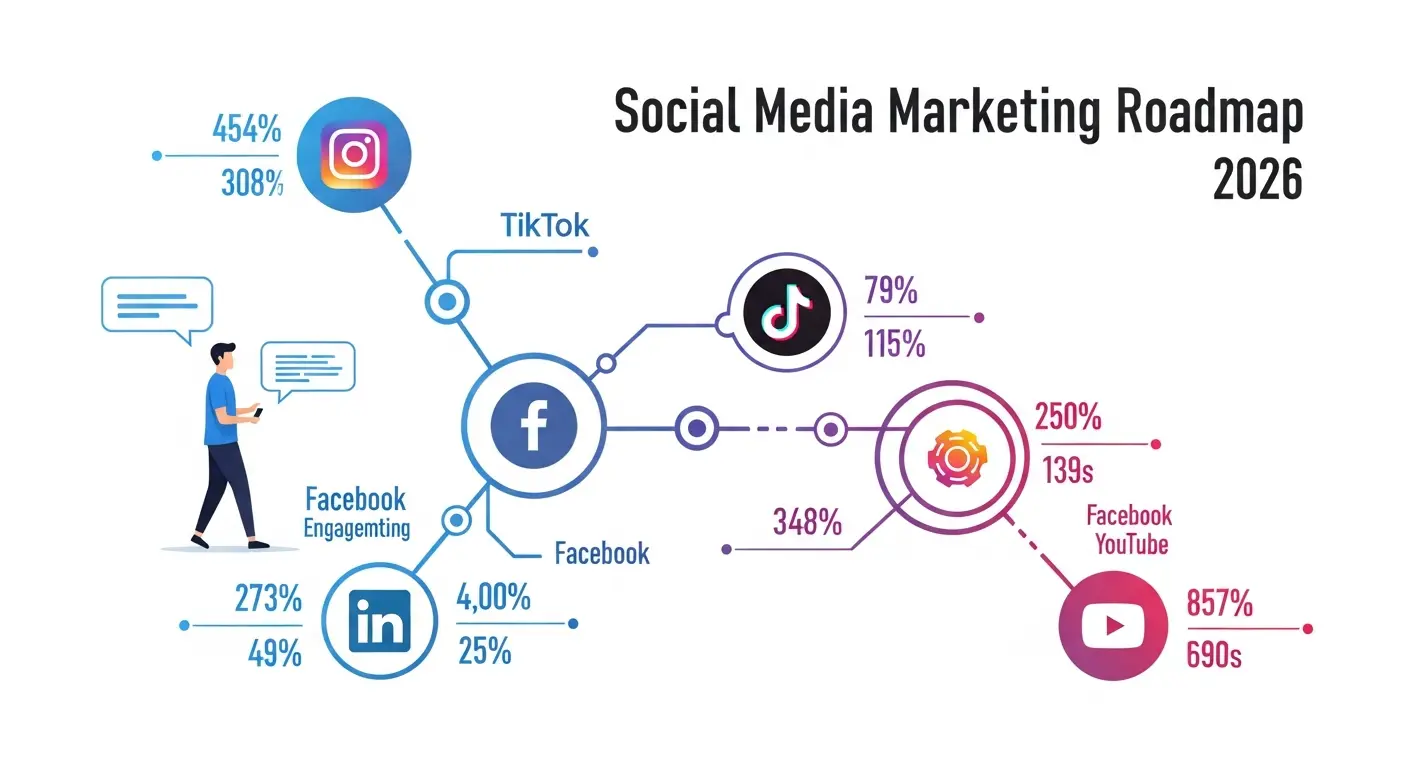
With 5.79 billion social media users worldwide and global ad spending projected to reach $276.7 billion in 2025, social media marketing has become essential for every business and brand. This isn’t just about posting content anymore, it’s about strategic communication that drives measurable business results.
This social media marketing roadmap provides a structured path from beginner to professional. You’ll learn platform-specific strategies, discover the tools professionals use, and understand how to build a career in one of marketing’s fastest-growing fields.
What Is Social Media Marketing?
Social media marketing is the practice of using social platforms to connect with audiences, build brand awareness, drive website traffic, and increase sales, one of the core channels within digital marketing. It encompasses organic content creation, community management, paid advertising, influencer partnerships, and data analytics.
Unlike traditional advertising, social media marketing enables two-way communication between brands and consumers. This creates opportunities for authentic engagement, real-time customer service, and community building that traditional channels simply cannot match.
The scope of social media marketing includes: content strategy and creation, community management, paid social advertising, influencer marketing, social listening and monitoring, analytics and reporting, and crisis management.
Why Learn Social Media Marketing in 2026?
The data overwhelmingly supports social media marketing as a critical skill for the modern economy.
The audience is massive and growing. There are now 5.79 billion social media users worldwide, representing over two-thirds of the global population. This figure is projected to reach 6.05 billion by 2028. The typical user engages with 6.75 different social platforms each month and spends an average of 2 hours and 21 minutes daily on social media.
Brands depend on social media. According to industry research, 86% of professionals report that social media increases brand exposure, and 77% of businesses use social media to reach their audience. For Gen Z consumers, 77% discover new products through TikTok, making platform expertise essential for reaching younger demographics.
Investment continues growing. Social media is now the top global media channel for advertising investment, surpassing paid search. Social media ad spend reached $247.3 billion in 2024 and is projected to hit $276.7 billion in 2025. Companies are allocating more budget than ever to social marketing.
Career opportunities are strong. The average social media manager salary in the United States is $71,408 per year according to Glassdoor, with top earners making $124,389 annually. Entry-level positions start around $47,500, while senior roles exceed $95,000.
Social Media Marketing Salary Guide (USA 2025)
| Role | Average Salary | Range |
|---|---|---|
| Social Media Coordinator | $47,500 | $35,000 – $58,000 |
| Social Media Specialist | $55,200 | $45,000 – $68,000 |
| Social Media Manager | $71,408 | $53,571 – $95,917 |
| Social Media Marketing Manager | $86,390 | $64,793 – $120,947 |
| Social Media Director | $112,750 | $89,366 – $134,873 |
| Head of Social Media | $125,000+ | $100,000 – $160,000+ |
Freelance social media managers typically earn between $103,550 and $132,170 annually, with rates per post ranging from $10 to $300 depending on experience, platform, and content type.
Complete Social Media Marketing Roadmap: 8 Phases
Phase 1: Master Social Media Fundamentals (Week 1-2)
Before diving into tactics, understand the strategic foundations that drive social media success.
Core concepts to learn:
Understand the difference between organic and paid social media. Organic content builds community and trust over time without direct payment, while paid social involves sponsored posts and advertisements that reach targeted audiences immediately.
Learn the customer journey on social media. Users move from awareness (discovering your brand) to consideration (evaluating your offering) to conversion (taking action) to advocacy (recommending to others). Each stage requires different content approaches.
Study platform algorithms. Every platform uses algorithms to determine what content users see. Understanding how these algorithms work (prioritizing engagement, watch time, relevance, and recency) is fundamental to content strategy.
Key metrics to understand: reach, impressions, engagement rate, click-through rate, conversion rate, follower growth rate, share of voice, and sentiment analysis.
Phase 2: Understand Platform Ecosystems (Week 3-6)
Each social platform serves different audiences and requires distinct strategies. Master the major platforms individually before attempting cross-platform campaigns.
Platform Overview 2025:
| Platform | Monthly Active Users | Key Demographics | Best Content Types |
|---|---|---|---|
| 3.07 billion | 25-54, balanced gender | Video, links, community groups | |
| YouTube | 2.58 billion | All ages, slight male skew | Long-form video, Shorts |
| 2 billion | 18-34, balanced gender | Reels, Stories, carousels | |
| TikTok | 1.99 billion | 18-34, balanced gender | Short-form video, trends |
| 1.33 billion | 25-55, professionals | Articles, thought leadership | |
| 553 million | 70% female, 25-44 | Visual pins, product discovery | |
| X (Twitter) | 611 million | 25-49, 64% male | Real-time updates, news, threads |
Platform engagement rates (2025):
TikTok leads with an average engagement rate of 2.80-4.86%, making it the most interactive platform. YouTube follows with 4.41%, while LinkedIn surprisingly leads some metrics at 6.50% for professional content. Instagram’s engagement has declined to 0.45-1.16%, emphasizing the need for high-quality, strategic content. Facebook maintains steady engagement around 0.20-5.07% depending on content type.
Platform-specific strategies:
For TikTok, prioritize authenticity over polish. Users spend an average of 47.3 minutes daily on TikTok, the highest of any major platform. TikTok’s algorithm rewards content that generates watch time and shares, not just followers. Educational content currently achieves 9.5% average engagement.
For Instagram, embrace Reels and carousels. Video content dominates, and 72% of Gen Z users turn to Instagram for customer service. Focus on visual consistency, Stories engagement, and responding to DMs promptly.
For LinkedIn, 85% of B2B marketers name it their highest-performing channel. Users accept AI-assisted recruitment messages 44% more often than regular DMs. Share industry insights, professional achievements, and thought leadership content.
Phase 3: Develop Content Strategy Skills (Week 7-12)
Content is the fuel that powers social media success. Develop skills in planning, creating, and optimizing content across formats.
Content pillars to master:
Create a content mix that serves different objectives. Educational content builds authority and trust. Entertaining content drives shares and reach. Inspirational content creates emotional connections. Promotional content drives conversions. User-generated content builds community.
Understand content formats. Short-form video (under 60 seconds) is 2.5 times more engaging than long-form video. 81% of consumers want brands to release more short-form videos. Carousel posts perform well on Instagram and LinkedIn. Live video generates authentic real-time engagement.
Develop a content calendar. Research from Hootsuite indicates brands should aim for 48-72 posts per week across platforms for optimal performance. This requires systematic planning and often AI assistance for content creation.
Content creation workflow:
Research trending topics using platform-native tools and social listening. Plan content themes aligned with business goals and audience interests. Create content in batches to maintain consistency. Schedule posts for optimal timing based on audience activity. Monitor performance and iterate based on data.
Phase 4: Build Community Management Skills (Week 13-16)
Community management transforms followers into fans and customers into advocates.
Engagement best practices:
Respond to comments and messages promptly. Facebook is the top platform consumers use for customer care, especially among Millennials, Gen X, and Baby Boomers. Gen Z prefers Instagram (72%) for customer service interactions.
Develop a brand voice that feels authentic and consistent. This voice should guide how you respond to positive feedback, handle complaints, and engage in conversations.
Proactive engagement drives results. Research shows brands experimenting with proactive outbound comments (commenting on posts by others) receive an average 1.6x more engagements when the original poster replies. Keep comments between 50-99 characters for best results.
Crisis management fundamentals:
Prepare response protocols before crises occur. Monitor brand mentions continuously using social listening tools. Respond quickly but thoughtfully to negative situations. Know when to take conversations private versus address publicly.
Phase 5: Master Paid Social Advertising (Week 17-22)
Organic reach limitations make paid social essential for scaling results. Learn advertising across major platforms.
Paid social fundamentals:
Understand campaign objectives. Awareness campaigns maximize reach and impressions. Consideration campaigns drive traffic, engagement, and video views. Conversion campaigns generate leads and sales.
Learn audience targeting. Platforms offer demographic, interest, behavioral, and custom audience targeting. Lookalike audiences help find new users similar to existing customers.
Master creative best practices. Video ads outperform static images on most platforms. A/B test different creative variations, headlines, and calls-to-action.
Platform advertising benchmarks (2024):
| Platform | Average CTR | Average CPC | Average CPL |
|---|---|---|---|
| 1.51% | $0.83 | Varies by industry | |
| 0.80% | $1.15 | Varies by industry | |
| 0.44% | $5.26 | $75-150 | |
| TikTok | 0.84% | $1.00 | Varies by industry |
For comprehensive paid advertising skills, develop expertise through a dedicated media buying and PPC roadmap.
Phase 6: Leverage Influencer Marketing (Week 23-26)
Influencer marketing has grown from $1.7 billion in 2015 to $32.55 billion in 2025, and it shares many commission-based principles with affiliate marketing. Understanding this channel is essential.
Influencer marketing fundamentals:
Understand influencer tiers. Nano-influencers (under 10,000 followers) typically deliver higher engagement rates and more authentic connections. Research shows a $50 investment with a nano-influencer yields an average return exceeding $1,000, while macro-influencers often charge over $1,000 but generate an average return of only $6,000.
TikTok dominates influencer marketing, with 68.8% of brands using it for influencer campaigns. This surpasses Instagram (47%), YouTube (33%), and Facebook (28%).
37% of Gen Z purchased products recommended by influencers in the past three months. 64% of consumers are more likely to purchase from a brand that collaborates with an influencer they follow.
Partnership strategies:
Identify influencers whose audience matches your target market. Evaluate based on engagement rate, content quality, and brand alignment, not just follower count. Develop clear briefs that allow creative freedom while meeting brand guidelines. Track performance using unique links, promo codes, and platform analytics.
Phase 7: Analytics and Optimization (Week 27-30)
Data-driven decision making separates professional social media marketers from amateurs.
Key metrics by objective:
For awareness: reach, impressions, follower growth rate, share of voice. For engagement: engagement rate, comments, shares, saves, average watch time. For traffic: click-through rate, website sessions from social, bounce rate. For conversions: conversion rate, cost per conversion, return on ad spend.
Analytics tools and practices:
Use platform-native analytics as your foundation. Facebook Insights, Instagram Insights, TikTok Analytics, and LinkedIn Analytics provide essential performance data.
Layer additional tools for deeper insights. Google Analytics 4 tracks website traffic from social. Social listening tools monitor brand mentions and sentiment. Competitive analysis tools benchmark performance against competitors.
Develop regular reporting cadences. Weekly performance reviews identify quick wins and issues. Monthly reports track trend analysis and strategy adjustments. Quarterly reviews assess progress toward larger goals.
Phase 8: Advanced Strategies and AI Integration (Week 31-36)
Stay current with emerging trends and technologies shaping social media’s future.
AI in social media marketing:
AI adoption has accelerated dramatically. 61% of social media managers cite AI as their top motivation for reducing workload. Organizations in regulated industries are now leading AI adoption faster than unregulated counterparts.
AI applications include content ideation and creation, caption writing, hashtag optimization, optimal posting time recommendations, predictive analytics, chatbot automation, and social listening analysis.
72% of marketers report better results with AI-generated content, and 75% say AI boosts creativity. However, authenticity remains crucial: audiences can detect purely AI-generated content that lacks human insight.
Social commerce:
TikTok dominates social commerce, converting 43.8% of users into buyers in 2024. Facebook remains the top platform for direct purchases (39%), followed by TikTok (36%) and Instagram (29%). Over 50% of Gen Z purchased products directly on social platforms in 2024.
Essential Social Media Marketing Tools
| Category | Tool | Starting Price | Best For |
|---|---|---|---|
| All-in-One | Hootsuite | $99/month | Enterprise social management |
| All-in-One | Sprout Social | $259/seat/month | Analytics + influencer marketing |
| Budget-Friendly | Buffer | $6/channel/month | Small businesses, solopreneurs |
| Scheduling | Later | $25/month | Instagram + TikTok focus |
| Agency | SocialPilot | $30/month | Multi-client management |
| Analytics | Socialinsider | $99/month | Competitive benchmarking |
| Design | Canva | Free / $13/month | Visual content creation |
| Video | CapCut | Free | Short-form video editing |
| Listening | Brand24 | $119/month | Social listening + monitoring |
| Automation | ManyChat | Free / $15/month | Chatbot + DM automation |
Social Media Marketing Certifications
| Certification | Provider | Cost | Duration | Validity |
|---|---|---|---|---|
| Social Media Marketing | HubSpot Academy | Free | 5 hours | 2 years |
| Social Media Marketing | Hootsuite Academy | $199 | 6 hours | Lifetime |
| Meta Social Media Marketing | Meta (Coursera) | $59/month | 5 months | N/A |
| Meta Digital Marketing Associate | Meta Blueprint | $99-150 | Self-paced | 24 months |
| Social Media Certificate | eCornell | $3,600 | 2 months | N/A |
| Digital Marketing Fundamentals | Google Digital Garage | Free | 40 hours | N/A |
Professionals completing certifications have experienced an average 38% salary increase post-certification according to industry data. Major employers including Unilever, L’Oréal, and Dell Technologies now require social media certifications in job listings.
Career Paths in Social Media Marketing
Entry-level roles (0-2 years): Social Media Coordinator, Social Media Assistant, Community Manager
Mid-level roles (2-5 years): Social Media Manager, Content Strategist, Paid Social Specialist
Senior roles (5+ years): Social Media Director, Head of Social, VP of Social Media
Freelance opportunities: Many social media professionals transition to freelance work, managing multiple clients. Freelance social media managers earn between $8,629 and $11,014 per month on average.
Related skill development:
Strong social media marketers often expand into broader digital marketing roles. Content creation skills transfer directly to blogging and content creation. Paid social expertise builds foundation for performance marketing.
Frequently Asked Questions
How long does it take to learn social media marketing?
Basic competency can be achieved in 3-6 months with consistent study and practice. Professional-level skills typically develop over 1-2 years of hands-on experience. The field evolves constantly, so continuous learning is essential throughout your career.
Which social media platform should beginners focus on first?
Start with one or two platforms where your target audience is most active. For B2B marketing, LinkedIn offers the highest ROI with 85% of B2B marketers naming it their top channel. For consumer brands targeting younger audiences, Instagram and TikTok provide strong engagement opportunities.
Do I need a degree to become a social media manager?
No degree is required. Many successful social media managers are self-taught or hold certifications rather than formal degrees. Employers increasingly value demonstrated skills, portfolio work, and platform-specific certifications over traditional education credentials.
How much can I charge as a freelance social media manager?
Freelance rates vary widely based on experience, scope, and client size. Beginners typically charge $500-$1,500 per month per client for basic management. Experienced freelancers command $2,000-$5,000+ monthly, especially for clients requiring strategy, content creation, and paid advertising management.
What’s the difference between social media marketing and digital marketing?
Social media marketing is a subset of digital marketing focused specifically on social platforms. Digital marketing encompasses all online marketing channels including SEO, email marketing, PPC advertising, content marketing, and social media. Most social media marketers eventually develop broader digital marketing skills.
Is social media marketing a good career in 2026?
Yes. With social media ad spending exceeding $276 billion and 5.79 billion users worldwide, demand for skilled social media professionals remains strong. The field offers diverse career paths, competitive salaries, and opportunities for both employed and freelance work.
Key Takeaways
- 5.79 billion social media users worldwide, projected to reach 6.05 billion by 2028
- Average social media manager salary: $71,408, with top earners exceeding $124,000
- TikTok leads engagement at 2.80-4.86%, with users spending 47.3 minutes daily on platform
- 86% of professionals report social media increases brand exposure
- Influencer marketing industry worth $32.55 billion in 2025
- LinkedIn delivers 6.50% engagement rate, highest among major platforms for professional content
- Brands should aim for 48-72 posts per week across platforms for optimal performance
- Social media now the top global channel for advertising investment
Your Next Steps
Start by auditing your current social media presence or creating accounts on key platforms. Choose one platform to master first based on your career goals and target audience. Complete a free certification from HubSpot Academy to build foundational knowledge.
Practice by managing your own profiles or offering services to a small business or nonprofit. Document results and build a portfolio of work samples. Track your learning using this roadmap, progressing through each phase systematically.
Social media marketing rewards those who stay curious and adapt quickly. Algorithms change, new platforms emerge, and audience preferences shift. The professionals who thrive are those who embrace continuous learning while building deep expertise in proven fundamentals.