
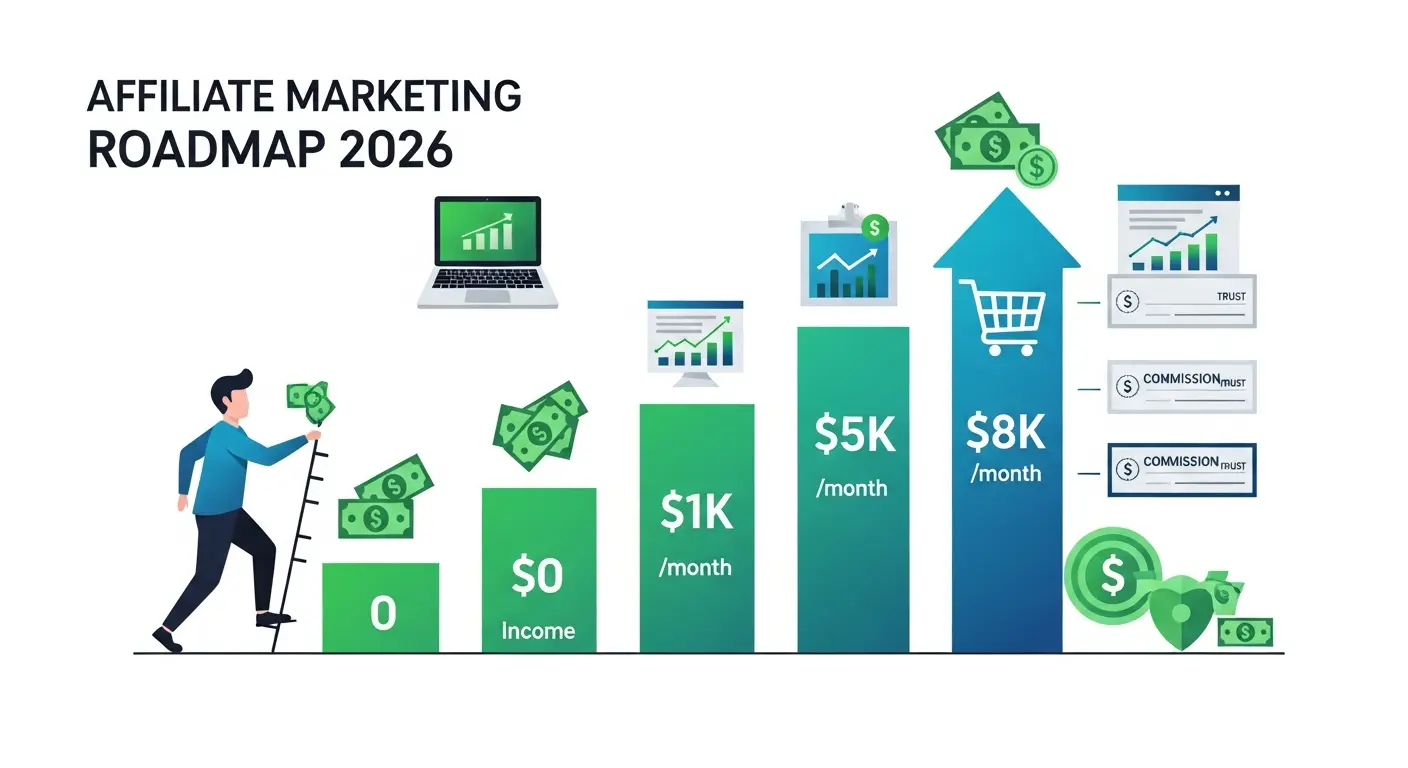
Affiliate marketing remains one of the most accessible paths to building online income in 2026. With average affiliates earning $8,038 per month and the U.S. market projected to reach $12 billion in spending, the opportunity continues to expand for newcomers and experienced marketers alike.
This affiliate marketing roadmap provides a clear, data-backed path from complete beginner to profitable affiliate. You’ll learn exactly which niches pay the most, which programs to join, and the proven strategies top affiliates use to generate consistent commissions.
What Is Affiliate Marketing?
Affiliate marketing is a performance-based business model, one of the core channels within digital marketing, where you earn commissions by promoting other companies’ products or services. When someone purchases through your unique affiliate link, you receive a percentage of the sale or a fixed bounty.
Unlike traditional employment, affiliate marketing offers uncapped earning potential. You can promote multiple products simultaneously, work from anywhere, and build assets that generate income while you sleep.
The core process works like this: You join an affiliate program, receive a unique tracking link, promote products to your audience through content or ads, and earn commissions when your referrals convert into paying customers.
Why Start Affiliate Marketing in 2026?
The data strongly supports affiliate marketing as a business model for 2026 and beyond.
The industry is booming. U.S. affiliate marketing spending reached $10.72 billion in 2024 and is projected to hit nearly $12 billion in 2025, with continued growth expected to push the market to $16 billion by 2028. Globally, the industry is valued at $18.5 billion and expected to reach $31.7 billion by 2031.
Businesses depend on affiliates. Over 84% of brands now run affiliate programs, and affiliate marketing drives 16% of all online orders in the United States and Canada. This means companies are actively seeking partners like you to promote their products.
The ROI is exceptional. Businesses see an average return of $12 for every $1 spent on affiliate marketing, making it one of the most cost-effective marketing channels available. This ensures companies will continue investing in affiliate partnerships.
Low barrier to entry. Unlike starting a traditional business, affiliate marketing requires minimal upfront investment. You need a laptop, internet connection, and willingness to learn. No inventory, no customer service, no shipping logistics.
Affiliate Marketing Income: Realistic Expectations
Understanding realistic income expectations helps you set proper goals and avoid scams promising overnight riches.
Income by Experience Level
| Experience Level | Monthly Income | Timeline to Reach |
|---|---|---|
| Beginner (0-1 year) | $0 – $1,000 | 0-12 months |
| Intermediate (1-3 years) | $1,000 – $10,000 | 12-36 months |
| Advanced (3-5 years) | $10,000 – $100,000 | 36-60 months |
| Super Affiliate (5+ years) | $100,000+ | 60+ months |
The average affiliate marketer earns $8,038 per month according to Authority Hacker’s research. However, this average is skewed by super affiliates earning six and seven figures. The median income is significantly lower, with 41% of affiliates earning less than $1,000 monthly.
Key insight: 80% of affiliates fall between beginner and advanced categories, earning $0 to $80,000 annually. Only 15% earn $80,001 to $1 million per year, and just 1% achieve six or seven figures monthly.
Employed Affiliate Marketing Salaries (USA)
For those pursuing affiliate marketing as a career rather than independent business:
| Role | Average Salary | Range |
|---|---|---|
| Affiliate Marketer | $70,370 | $60,682 – $86,329 |
| Affiliate Marketing Specialist | $82,015 | $66,000 – $125,000 |
| Affiliate Marketing Manager | $96,549 | $72,412 – $176,684 |
Complete Affiliate Marketing Roadmap: 7 Phases
Phase 1: Choose Your Niche (Week 1-2)
Your niche determines everything from commission rates to content strategy. The best niches combine personal interest with profit potential.
Most Profitable Affiliate Niches in 2026:
| Niche | Average Monthly Earnings | Commission Range |
|---|---|---|
| Finance & Investing | $9,296 | $50-$200 per lead |
| Software & SaaS | $7,500+ | 20-50% recurring |
| Health & Supplements | $7,194 | $100-$200+ per sale |
| Education & E-learning | $5,000-$15,000 | 20-50% per sale |
| Web Hosting & Tech | $5,000+ | $65-$200 per sale |
| Pet Products | $3,000-$8,000 | 10-20% per sale |
Niche selection criteria:
Passion and knowledge matter because affiliate marketing requires consistent content creation over months or years. Choose something you can write about extensively without burning out.
Search volume indicates demand. Use free tools like Google Trends and Ubersuggest to verify people actively search for products in your niche.
Commission potential varies dramatically. SaaS products often pay 20-50% recurring commissions, while Amazon pays just 1-10% one-time. Higher commissions mean fewer sales needed to reach income goals.
Competition level affects difficulty. Broad niches like “weight loss” are saturated. Sub-niches like “intermittent fasting for women over 40” offer better opportunities for new affiliates.
Phase 2: Build Your Platform (Week 3-6)
Every successful affiliate needs a platform to reach potential buyers. Your platform choice depends on your strengths and target audience.
Platform comparison:
| Platform | Time to Revenue | Best For | Investment |
|---|---|---|---|
| Blog/Website | 6-18 months | SEO, evergreen content | $100-500/year |
| YouTube | 3-12 months | Product reviews, tutorials | $0-2,000 (equipment) |
| TikTok/Instagram | 1-6 months | Trending products, younger audience | $0-500 |
| Email List | 3-9 months | Highest conversion rates | $0-50/month |
| Podcast | 6-12 months | Trust building, niche authority | $200-1,000 |
For beginners, I recommend starting with a blog because 69% of successful affiliates use SEO as their primary traffic source, and blogs create lasting assets that generate traffic for years. Content affiliates see average conversion rates of 3-5%.
Essential website setup:
Domain and hosting cost $50-150 per year through providers like Bluehost, SiteGround, or Hostinger. WordPress powers most affiliate sites due to its flexibility and SEO capabilities.
Install essential plugins including an SEO plugin (Yoast or RankMath), caching plugin for speed, and affiliate link management tool like ThirstyAffiliates or Pretty Links.
Action step: Purchase your domain, set up WordPress hosting, and install a clean theme within the first two weeks.
Phase 3: Join Affiliate Programs (Week 7-8)
With your platform established, apply to affiliate programs matching your niche.
Top Affiliate Networks and Programs:
| Program/Network | Commission Rate | Cookie Duration | Best For |
|---|---|---|---|
| Amazon Associates | 1-10% | 24 hours | Physical products, beginners |
| ShareASale | Varies (5-50%) | 30-90 days | Multiple niches |
| CJ Affiliate | Varies | 30-45 days | Major brands |
| ClickBank | 50-75% | 60 days | Digital products |
| Impact | Varies | 30+ days | SaaS, enterprise brands |
| PartnerStack | 20-50% recurring | 90 days | B2B SaaS |
High-Paying Individual Programs:
| Program | Commission | Cookie Duration | Payout |
|---|---|---|---|
| HubSpot | 30% recurring (1 year) | 180 days | Up to $12,960/year per customer |
| Semrush | $200/sale + $10/trial | 120 days | Monthly via Impact |
| Shopify | Up to $150/referral | 30 days | Bi-weekly |
| Bluehost | $65-$100/sale | 90 days | Monthly via Impact |
| Teachable | 30% recurring | 90 days | Monthly |
| ConvertKit | 30% recurring | 90 days | Monthly |
| AWeber | Up to 50% recurring lifetime | 365 days | Monthly |
Application tips: Programs review your website before approval. Have at least 5-10 quality posts published before applying. Explain how you’ll promote their products and your traffic strategy.
Phase 4: Create Converting Content (Week 9-16)
Content drives affiliate success. The right content attracts buyers, builds trust, and generates conversions.
Highest-converting content types:
Product reviews perform exceptionally well because readers have high purchase intent. Structure reviews with honest pros and cons, comparison with alternatives, and clear recommendations.
“Best of” listicles like “Best Email Marketing Software 2026” capture comparison shoppers actively researching options. These posts can rank for multiple product keywords simultaneously.
Tutorial content showing how to use products demonstrates value and builds trust. Readers seeing your expertise are more likely to purchase through your links.
Problem-solution content addresses specific pain points your affiliate products solve. “How to Start an Online Store” naturally leads to Shopify affiliate links.
Content creation schedule:
Publish 2-4 high-quality posts weekly for the first three months. Focus on long-tail keywords with buyer intent (containing words like “best,” “review,” “vs,” “alternative”). Each post should be 1,500-3,000 words with genuine value beyond affiliate links.
Phase 5: Drive Traffic (Week 17-24)
Traffic equals opportunity. Without visitors, even the best content won’t generate commissions.
Traffic strategies ranked by effectiveness:
SEO (Search Engine Optimization) drives 53% of website traffic on average and remains the most sustainable long-term strategy. Affiliates using email marketing earn 66.4% more than those who don’t, making list building essential.
Learn keyword research using tools like Ubersuggest (free), Ahrefs, or Semrush. Target keywords with commercial intent and reasonable competition. Build backlinks through guest posting, broken link building, and creating linkable assets.
For comprehensive SEO guidance, follow a structured SEO roadmap to build organic traffic systematically.
Social media marketing provides faster initial results. Platforms like Pinterest, YouTube, and TikTok can generate traffic within weeks rather than months. Learn platform-specific strategies through a dedicated social media marketing roadmap.
Email marketing delivers the highest conversion rates. Visitors who join your email list are 10x more likely to purchase than first-time visitors. Build your list from day one using lead magnets, content upgrades, and exit-intent popups.
Paid advertising accelerates results but requires budget and skill. Facebook Ads, Google Ads, and native advertising can drive immediate traffic. Master PPC and media buying before investing significant budget.
Phase 6: Optimize and Scale (Week 25-36)
Once traffic flows, optimization multiplies results without proportionally increasing effort.
Track everything. Use Google Analytics 4 to understand traffic sources, user behavior, and conversion paths. Most affiliate networks provide detailed reporting on clicks, conversions, and earnings per click (EPC).
A/B test continuously. Test different call-to-action placements, button colors, link text, and content formats. Small improvements compound into significant revenue increases.
Double down on winners. Identify your top-performing content and create more like it. If product reviews convert well, write more reviews. If certain products sell better, focus promotional efforts there.
Negotiate higher commissions. After proving your value with consistent sales, contact affiliate managers to request commission increases. Top performers often receive 20-50% higher rates than standard affiliates.
Diversify income streams. Don’t rely on a single affiliate program. Amazon’s commission cuts in 2020 devastated affiliates with no diversification. Promote multiple products across different programs.
Phase 7: Build Long-Term Assets (Month 12+)
Successful affiliates build businesses, not just income streams.
Expand content formats. Add YouTube videos, podcasts, or courses to reach new audiences. Video affiliates see 49% higher conversion rates than text-only content.
Build an email list aggressively. Email subscribers are your owned audience that no algorithm change can take away. A 10,000-person email list in a profitable niche can generate $5,000-$20,000 monthly.
Consider creating your own products. After understanding your audience deeply, create complementary products (courses, ebooks, software) that provide higher margins than affiliate commissions.
Automate and delegate. Use tools to schedule social posts, automate email sequences, and track performance. Hire writers, editors, or virtual assistants to handle repetitive tasks as revenue grows.
Essential Affiliate Marketing Tools
| Category | Tool | Starting Price | Purpose |
|---|---|---|---|
| Website | WordPress + Bluehost | $2.95/month | Website foundation |
| SEO | Ubersuggest | Free / $12/month | Keyword research |
| SEO | Ahrefs | $29/month | Backlink analysis |
| Link Management | ThirstyAffiliates | $79/year | Link cloaking, tracking |
| ConvertKit | Free (1K subs) | List building | |
| Analytics | Google Analytics 4 | Free | Traffic analysis |
| Design | Canva | Free / $13/month | Graphics creation |
| AI Writing | ChatGPT Plus | $20/month | Content assistance |
Common Mistakes to Avoid
Promoting too many products. Focus on 5-10 core products you genuinely recommend rather than overwhelming visitors with endless affiliate links.
Ignoring disclosure requirements. The FTC requires clear affiliate disclosure. Always disclose affiliate relationships prominently on your content.
Expecting overnight results. Most affiliates see their first commission within 3-6 months. Significant income typically requires 12-24 months of consistent effort.
Choosing products solely on commission. High commissions mean nothing if products don’t convert or damage your reputation. Promote products you would personally use.
Neglecting content quality. AI makes content creation easier, but readers increasingly want unique insights and genuine experience. Differentiate through authentic expertise.
Frequently Asked Questions
How much money can beginners make with affiliate marketing?
Beginners typically earn $0-$1,000 per month during their first year. Most new affiliates earn their first commission within 3-6 months of consistent effort. The average affiliate marketer earns $8,038 monthly, but this includes experienced marketers. Setting realistic expectations of $500-$2,000 monthly in year one helps avoid disappointment.
How long does it take to make money with affiliate marketing?
Most affiliates see their first commission within 3-6 months. Reaching $1,000 monthly typically takes 6-12 months. Building a full-time income ($5,000+/month) usually requires 18-36 months of consistent work. Speed depends on niche selection, content quality, traffic strategy, and time invested.
Is affiliate marketing still profitable in 2026?
Yes, affiliate marketing remains highly profitable. The industry is projected to reach $12 billion in U.S. spending by 2025 and $16 billion by 2028. Over 84% of brands run affiliate programs, and the channel drives 16% of all e-commerce orders. While competition has increased, opportunities remain abundant in underserved niches.
What’s the best affiliate program for beginners?
Amazon Associates is ideal for beginners due to easy approval, millions of products, and brand trust. However, commissions are low (1-10%). For higher earnings, consider ShareASale or CJ Affiliate for diverse options, or niche-specific programs like Bluehost (web hosting) or ConvertKit (email marketing) if relevant to your content.
Do I need a website for affiliate marketing?
While not strictly required, a website dramatically improves success rates. Websites provide SEO opportunities, professional credibility, and full control over your platform. Social media alternatives (YouTube, TikTok, Instagram) work but leave you dependent on algorithm changes. Most successful affiliates combine a website with social media presence.
What’s the difference between affiliate marketing and dropshipping?
Affiliate marketing earns commissions by referring customers to other companies. You never handle products, inventory, or customer service. Dropshipping involves selling products under your brand, handling orders, and managing customer relationships while a supplier ships products. Affiliate marketing offers simpler operations with lower profit margins per sale.
Key Takeaways
- U.S. affiliate marketing spending projected to reach $12 billion in 2025 and $16 billion by 2028
- Average affiliate earns $8,038/month, with beginners typically making $0-$1,000 in year one
- 16% of all U.S. e-commerce orders come through affiliate marketing
- 69% of successful affiliates use SEO as their primary traffic source
- SaaS and finance niches offer highest commissions (20-50% recurring)
- Email marketing increases affiliate earnings by 66.4% compared to non-email affiliates
- Expect 6-12 months before reaching consistent $1,000+ monthly income
- Top affiliate programs include Amazon Associates (beginners), ShareASale, ClickBank, and niche-specific programs
Your Next Steps
Affiliate marketing rewards consistent action over perfection. Start your niche research today, secure your domain this week, and publish your first piece of content within 14 days.
The path to affiliate income is clear: choose a profitable niche you enjoy, build a platform, join relevant programs, create valuable content, drive targeted traffic, and optimize based on data.
While affiliate marketing connects closely with broader digital marketing skills, you can start earning commissions with focused effort in a single niche. As you grow, consider expanding into email marketing for higher conversions and content creation for sustainable traffic growth.
The $12 billion affiliate industry has room for dedicated newcomers. Your first commission is closer than you think.