
In 2024, internet users spent $560 billion on digital media including ebooks, courses, music, and games. The digital products market exceeds $600 billion globally, with 68% of people aged 16+ paying for digital content monthly. Course creators on platforms like Kajabi have collectively earned over $8 billion, while Thinkific creators earned $340 million in 2023 alone. The ebooks market generated $14.9 billion in 2025, growing steadily toward $16 billion by 2030.
This digital products selling roadmap provides a complete path from identifying profitable product ideas to creating, launching, and scaling your digital product business. Whether you want to sell online courses, ebooks, templates, or memberships, this guide covers the strategies, platforms, and tools you need to build sustainable passive income in 2026.
What Are Digital Products?
Digital products are intangible goods delivered electronically—files, content, or access that customers receive instantly without physical shipping. Unlike physical products, digital goods can be created once and sold infinitely with no additional production or fulfillment costs.
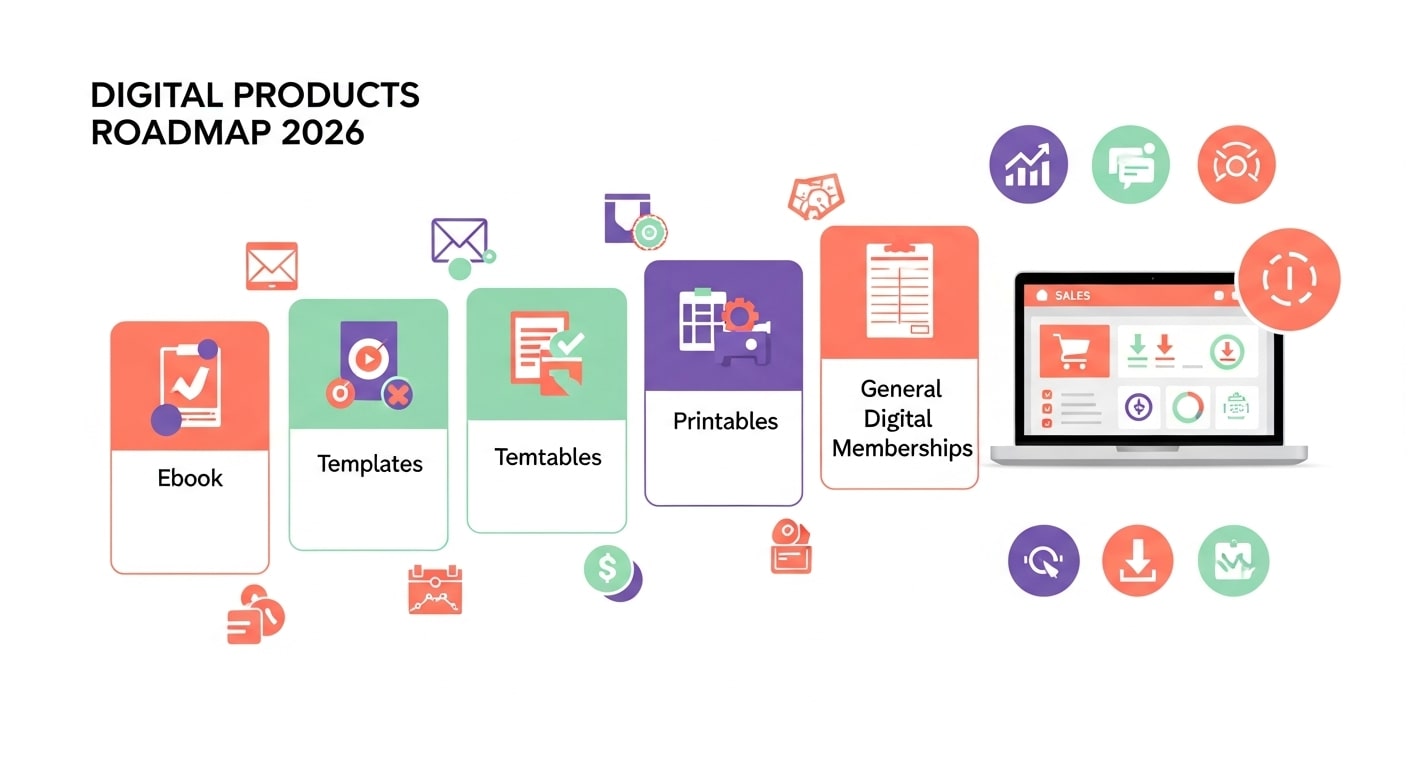
Major categories of digital products:
Educational products: Online courses, ebooks, workbooks, tutorials, coaching programs, and certification courses. The online education market is projected to reach $840 billion by 2030.
Creative assets: Templates, printables, stock photos, graphics, fonts, icons, and design elements. These serve businesses, marketers, and content creators.
Tools and software: Apps, plugins, spreadsheets, calculators, and SaaS products. Once built, these generate recurring revenue with minimal ongoing effort.
Content subscriptions: Memberships, newsletters, exclusive content libraries, and community access. These provide predictable recurring revenue.
Licensed media: Stock photography, music, sound effects, and video footage. Creators earn royalties each time their content is licensed.
Why Sell Digital Products in 2026?
The economics of digital products make them exceptionally attractive for creators and entrepreneurs.
Zero inventory and shipping. Unlike physical products, digital goods require no warehouse, no packaging, no shipping costs, and no inventory management. Create once, sell forever.
Near-infinite scalability. Selling to 10 customers costs the same as selling to 10,000. There’s no additional production cost per unit, making margins exceptionally high—often 80-95% profit.
Passive income potential. With automated delivery systems, digital products sell and deliver themselves 24/7. This creates genuine passive income once products are created and marketing systems are established.
Global reach. Digital products can be purchased and delivered anywhere in the world instantly. Your potential market is anyone with internet access.
Low startup costs. Unlike physical product businesses requiring manufacturing investment, you can start selling digital products with just your time, expertise, and basic tools (many free).
Growing market demand. Digital product transaction volume increased by nearly 70% between 2022 and 2024. Global spending on digital goods was expected to exceed $135 billion by 2024, with continued growth projected.
Digital Products Market Statistics (2024-2025)
| Metric | Value |
|---|---|
| Digital media spending (2024) | $560 billion |
| Global digital products market | $600+ billion |
| E-commerce market (2025) | $6.8 trillion |
| Ebooks market revenue (2025) | $14.9 billion |
| Online education market (projected 2030) | $840 billion |
| People paying for digital content monthly | 68% |
| Digital product transaction growth (2022-2024) | 70% |
Platform revenue data:
| Platform | Creator Earnings |
|---|---|
| Kajabi (lifetime) | $8+ billion |
| Thinkific (2023) | $340 million |
| Teachable (lifetime) | $500+ million |
| Udemy (instructor payments 2022) | $192 million |
| Gumroad (2023 revenue) | ~$21 million |
Digital Product Creator Income Guide (2025)
| Category | Average/Median Income |
|---|---|
| Kajabi creators (average) | $37,000/year |
| Top course creators | $50,000+/month |
| Most course creators | $1,000 – $10,000/month |
| Skillshare top teachers | $100,000+/year |
| Udemy instructors (75%) | Less than $1,000/year |
| Udemy top instructor | $1,000,000+ |
| E-learning pros ($100K+/year) | 70% cite courses as #1 revenue source |
Income by blog posts (for content creators):
| Post Count | Average Monthly Income |
|---|---|
| 50-99 posts | $205 |
| 100-299 posts | $1,000+ |
| 300-499 posts | $2,500+ |
| 1,000+ posts | $7,981 |
Top-earning niches for digital products:
| Niche | Median Monthly Income |
|---|---|
| Food | $9,169 |
| Personal Finance | $9,100 |
| Lifestyle | $5,174 |
| Travel | $5,000 |
| Health & Wellness | High growth |
| Business/Marketing | High demand |
Complete Digital Products Selling Roadmap: 8 Phases
Phase 1: Identify Your Profitable Niche (Week 1-3)
Your niche determines your audience, pricing potential, and long-term success. The best digital products solve specific problems for specific people.
Finding your profitable intersection:
Your expertise: What do you know that others want to learn? What skills have you developed professionally or personally? What questions do people ask you for help with?
Market demand: Are people actively searching for solutions? Use Google Trends, keyword research tools, and platform searches (Udemy, Amazon, Etsy) to validate demand.
Competition analysis: Some competition validates demand, but look for gaps—underserved angles, better delivery methods, or specific audience segments competitors ignore.
Monetization potential: Some niches support premium pricing (B2B, professional skills, high-stakes outcomes) while others are commoditized. Consider average transaction values and customer lifetime value.
Validation methods:
- Search Udemy, Skillshare, and Amazon for existing products in your topic
- Check Etsy for digital product bestsellers in your category
- Analyze Google search volume for related keywords
- Survey your existing audience (email list, social followers)
- Review customer complaints and negative reviews of competitors
High-demand digital product niches (2025):
- Personal development and self-improvement
- Business and entrepreneurship
- Health, fitness, and wellness
- Personal finance and investing
- Creative skills (design, photography, writing)
- Technology and software skills
- Productivity and organization
- Relationships and parenting
Phase 2: Choose Your Digital Product Type (Week 4-6)
Match your skills, time availability, and income goals to the right product type.
Online courses:
The most profitable category for knowledge entrepreneurs. Courses allow premium pricing ($100-$2,000+) and deep value delivery.
Pros: High revenue potential, establishes authority, scalable Cons: Higher production time, requires video/audio skills
Best for: Experts with teaching ability and structured knowledge
Ebooks and guides:
Lower barrier to entry than courses. The ebooks market generated $14.9 billion in 2025.
Pros: Fast to create, low production costs, easy distribution Cons: Lower price points ($7-$47 typical), higher volume needed
Best for: Writers, researchers, and experts who communicate well in writing
Templates and tools:
Save people time by providing ready-made solutions. Templates for Canva, Notion, spreadsheets, and documents are consistently in demand.
Pros: Solve immediate problems, repeat purchases, upsell potential Cons: Can be copied, need constant updating
Best for: Designers, productivity experts, and business professionals
Memberships and subscriptions:
Recurring revenue through ongoing access to content, community, or resources.
Pros: Predictable income, higher customer lifetime value, community building Cons: Requires consistent content creation, higher churn management
Best for: Creators with ongoing content production and community-building skills
Printables and digital art:
Digital files customers download and print themselves—planners, wall art, worksheets, invitations.
Pros: Simple to create, passive after launch, high margins Cons: Lower price points, competitive markets
Best for: Designers and creative professionals
Software and apps:
Higher complexity but exceptional scalability. Includes plugins, SaaS tools, and mobile apps.
Pros: Highest scalability, recurring revenue potential Cons: Requires technical skills or development budget
Best for: Developers or entrepreneurs with technical teams
Phase 3: Create Your Digital Product (Week 7-16)
Production quality and genuine value determine your product’s success and reputation.
Course creation process:
- Outline curriculum: Break knowledge into modules and lessons. Focus on transformation—what will students be able to do after completing your course?
- Choose format: Video (most engaging), audio, text, or hybrid. 2 million AI-generated course elements were created on Teachable in 2024—AI can accelerate production.
- Record content: Invest in decent audio (more important than video quality). Use screen recording, talking head, or slides depending on topic.
- Add engagement elements: Quizzes, worksheets, action items, and community discussion increase completion rates.
- Edit and polish: Clean up content, add captions, create supporting materials.
Ebook creation process:
- Outline structure: Create clear chapters addressing specific problems or topics
- Write content: Focus on actionable, valuable information
- Design layout: Use Canva, Adobe InDesign, or hire a designer
- Format for distribution: PDF for direct sales, EPUB/MOBI for Amazon KDP
Template creation process:
- Identify specific use cases: What exact problem does this template solve?
- Design in appropriate tool: Canva, Notion, Google Sheets, Figma
- Make editable: Ensure customers can customize to their needs
- Create variations: Offer multiple styles or purposes in bundles
AI-assisted creation:
52% of small businesses use AI for content creation. Use AI tools for:
- Outline and structure generation
- First draft creation
- Editing and improvement suggestions
- Repurposing content across formats
However, always add original insights, personal experience, and human quality control.
Phase 4: Select Your Selling Platform (Week 17-20)
Your platform choice affects fees, features, audience access, and brand control.
Course-specific platforms:
| Platform | Pricing | Best For |
|---|---|---|
| Thinkific | $36-149/month | Course creators wanting control |
| Teachable | $59-249/month | Beginners, ease of use |
| Kajabi | $149-399/month | All-in-one business platform |
| Podia | $33-89/month | Simple courses + downloads |
| LearnWorlds | $24-249/month | Interactive course experiences |
General digital product platforms:
| Platform | Fees | Best For |
|---|---|---|
| Gumroad | 9% fee (decreases with volume) | Indie creators, simplicity |
| Payhip | 5% fee (free plan) | Templates, ebooks |
| Sellfy | $29-99/month | Multiple product types |
| SendOwl | $9-39/month | Automated delivery |
| Stan Store | $29/month | Social media creators |
Marketplaces with built-in audiences:
| Platform | Fees | Best For |
|---|---|---|
| Etsy | $0.20 listing + 6.5% | Templates, printables, art |
| Creative Market | 40% of sales | Design assets |
| Udemy | 37-97% (varies) | Course marketplace exposure |
| Amazon KDP | 30-65% royalty | Ebooks, global reach |
| Skillshare | Royalty-based | Course creators, discovery |
| Envato | Commission-based | Premium creative assets |
Own website options:
| Platform | Cost | Best For |
|---|---|---|
| Shopify | $29-299/month | Full e-commerce control |
| WooCommerce | Free (hosting separate) | WordPress users |
| WordPress + plugins | Varies | Maximum customization |
Platform selection factors:
- Starting out: Use marketplaces (Etsy, Gumroad) for built-in traffic
- Building brand: Own platforms (Thinkific, Shopify) for control
- Scaling: All-in-one solutions (Kajabi) for integrated marketing
- Testing: Free/low-cost options to validate before investing
Phase 5: Price Your Digital Products (Week 21-22)
Pricing affects both revenue and perceived value. Don’t underprice—digital products should reflect the value of the outcome they deliver.
Pricing frameworks:
Value-based pricing: Price based on the outcome your product delivers, not time to create. A $500 course that saves someone $5,000 is underpriced.
Competitive anchoring: Research competitor pricing, then position yourself appropriately—premium, mid-market, or value depending on your differentiation.
Tiered pricing: Offer multiple versions (basic, standard, premium) to capture different customer segments and increase average order value.
Typical price ranges by product type:
| Product Type | Typical Range |
|---|---|
| Short ebooks | $7 – $27 |
| Comprehensive ebooks | $27 – $97 |
| Template bundles | $15 – $97 |
| Mini-courses | $47 – $197 |
| Flagship courses | $197 – $997 |
| Premium/certification courses | $997 – $5,000+ |
| Memberships | $9 – $99/month |
| Printables | $3 – $25 |
Pricing strategies:
- Launch pricing: Offer discounts for early buyers to generate reviews and momentum
- Bundle pricing: Combine related products for higher average order value
- Payment plans: Increase accessibility for premium products
- Pay What You Want: Works for lead magnets and audience building
- Subscription tiers: Multiple membership levels for different commitment levels
Phase 6: Build Your Sales Funnel (Week 23-28)
A sales funnel guides potential customers from awareness to purchase. Even simple funnels dramatically increase conversion rates.
Basic digital product funnel:
- Traffic source: Social media, SEO, ads, or partnerships drive visitors
- Lead magnet: Free valuable content (checklist, mini-course, template) captures email addresses
- Nurture sequence: Automated emails build trust and demonstrate expertise
- Sales page: Compelling page presents your offer with clear benefits
- Checkout: Simple, secure payment process
- Delivery: Automated product access or download
- Upsells/Cross-sells: Offer related products during or after purchase
Lead magnet ideas:
- Free mini-course or workshop
- Downloadable template or checklist
- Ebook chapter or sample content
- Free tool or calculator
- Video training series
Email marketing:
30% of marketers say email marketing provides the best ROI. Build sequences for:
- Welcome series (introduce yourself and value)
- Nurture content (build trust over time)
- Launch sequences (time-limited promotions)
- Abandoned cart recovery (reclaim lost sales)
Sales page essentials:
- Clear headline stating the transformation
- Problem/solution narrative
- Benefits over features
- Social proof (testimonials, reviews, results)
- Clear pricing and guarantee
- Strong call-to-action
Phase 7: Market Your Digital Products (Week 29-38)
Marketing determines whether your product succeeds or disappears. Focus on channels where your audience already spends time.
Social media marketing:
88% of Kajabi creators use social media as their primary lead generation channel. 1 in 3 people discover new products through social media.
Platform selection:
- Instagram/TikTok: Visual products, creative niches, younger audiences
- LinkedIn: B2B, professional development, career skills
- Pinterest: Templates, printables, visual content (drives long-term traffic)
- YouTube: Educational content, course previews
- Twitter/X: Thought leadership, quick tips, community building
Content marketing:
Create valuable free content that demonstrates expertise and attracts ideal customers:
- Blog posts optimized for SEO
- Video tutorials on YouTube
- Podcast appearances and guest content
- Social media educational content
Influencer partnerships:
63% of shoppers are more likely to buy products recommended by trusted influencers. Partner with creators in your niche for:
- Product reviews and testimonials
- Affiliate partnerships
- Joint ventures and collaborations
- Guest content exchanges
Paid advertising:
Social media accounts for 33% of all digital ad spending, exceeding $220 billion by end of 2024. Test ads on:
- Facebook/Instagram for most consumer products
- Pinterest for visual products
- Google for search-intent purchases
- YouTube for educational products
Phase 8: Scale and Optimize (Week 39-52+)
Once your product is selling, focus on increasing revenue and efficiency.
Product expansion:
- Upsells: Offer premium versions or add-ons during purchase
- Cross-sells: Recommend related products
- Product suites: Create complementary products that work together
- Bundles: Package products for higher average order value
- Subscriptions: Convert one-time buyers to recurring revenue
Automation:
- Automate product delivery with your platform
- Set up abandoned cart email sequences
- Create evergreen webinar funnels
- Use scheduling tools for consistent social posting
- Implement customer support automation (FAQs, chatbots)
Optimization:
- Test different prices and pricing structures
- A/B test sales page elements
- Gather and display customer testimonials
- Improve products based on feedback
- Expand to additional platforms
Metrics to track:
| Metric | Target |
|---|---|
| Conversion rate | 2-5% (cold traffic), 10%+ (warm traffic) |
| Email open rate | 20-30%+ |
| Email click rate | 2-5%+ |
| Customer lifetime value | Increasing over time |
| Refund rate | Under 5% |
| Customer acquisition cost | Less than customer LTV |
Essential Tools for Digital Product Creators
| Category | Tool | Cost | Best For |
|---|---|---|---|
| Course creation | Thinkific | $36/mo | Hosting and selling courses |
| Course creation | Loom | Free – $12.50/mo | Screen recording |
| Design | Canva | Free – $12.99/mo | Templates, graphics |
| Design | Adobe Creative Cloud | $54.99/mo | Professional design |
| Writing | Google Docs | Free | Ebook drafting |
| ConvertKit | Free – $29/mo | Creator email marketing | |
| Mailchimp | Free – $13/mo | Beginner email | |
| Payments | Stripe | 2.9% + $0.30 | Payment processing |
| Payments | PayPal | 2.9% + $0.30 | Alternative payments |
| Landing pages | Carrd | Free – $19/year | Simple landing pages |
| Automation | Zapier | Free – $29/mo | Workflow automation |
| Analytics | Google Analytics 4 | Free | Traffic analysis |
Best Digital Products to Sell in 2026
| Product Type | Demand Level | Typical Price | Profit Margin |
|---|---|---|---|
| Online courses | Very High | $97 – $997 | 80-95% |
| Ebooks | High | $9 – $47 | 90-95% |
| Templates (Canva, Notion) | Very High | $15 – $97 | 95%+ |
| Printables | High | $3 – $25 | 95%+ |
| Memberships | High | $9 – $99/mo | 85-95% |
| Stock photos/videos | Medium | Royalty-based | Varies |
| Audio/music | Medium | $5 – $50+ | 90%+ |
| Software/plugins | High | $29 – $299+ | 80-90% |
| AI prompts/tools | Growing | $10 – $99 | 95%+ |
| Spreadsheet templates | High | $9 – $47 | 95%+ |
Frequently Asked Questions
How much money can I make selling digital products?
Income varies dramatically based on product type, niche, marketing, and effort. Kajabi creators average $37,000/year, while top creators earn $50,000+/month. Most course creators earn $1,000-$10,000/month. Start with realistic expectations—most beginners earn their first $100-$1,000 within 3-6 months, then scale from there.
What digital products sell best?
Online courses, templates (Notion, Canva, spreadsheets), ebooks, and printables consistently perform well. Trending products include AI tools and prompt packs, productivity templates, and subscription-based content. Products solving specific problems for defined audiences outperform generic offerings.
Which platform is best for selling digital products?
It depends on your product type and goals. For courses, Thinkific and Teachable offer the best balance of features and pricing. For simple downloads, Gumroad provides easy setup with no monthly fees. For built-in audiences, Etsy (templates/printables) and Amazon KDP (ebooks) provide marketplace exposure. Start with one platform, then expand.
How long does it take to create a digital product?
Simple products like templates or short ebooks can be created in a few hours to a few days. Comprehensive ebooks take 2-8 weeks. Online courses typically require 4-12 weeks depending on length and production quality. Start with smaller products to validate demand before investing in larger productions.
Do I need a large audience to sell digital products?
No. Many successful digital product creators started with zero audience. Marketplace platforms (Etsy, Udemy, Amazon) provide built-in traffic. However, building an email list and social following significantly increases long-term success. Focus on growing your audience alongside product creation.
How do I protect my digital products from piracy?
Use platforms with built-in protection (download limits, unique links). Watermark digital files where appropriate. Consider DRM for high-value products. Accept that some piracy is inevitable—focus on providing value to paying customers rather than obsessing over protection. Offer excellent support and community access that pirates don’t receive.
Key Takeaways
- Digital products market exceeds $600 billion globally with 68% of adults paying for digital content monthly
- Internet users spent $560 billion on digital media in 2024
- Course creators on major platforms have collectively earned billions (Kajabi $8B+, Thinkific $340M in 2023)
- Average Kajabi creator earns $37,000/year; top creators exceed $50,000/month
- Online education market projected to reach $840 billion by 2030
- Digital products offer 80-95% profit margins with zero inventory costs
- 88% of successful creators use social media as their primary lead generation channel
- Gumroad saw 96% revenue growth in 2023, indicating strong indie creator demand
Your Next Steps
Start by identifying one specific problem you can solve for a defined audience. Validate demand by researching existing products on marketplaces like Udemy, Etsy, and Amazon.
Create a minimum viable product—your first version doesn’t need to be perfect. A simple ebook, template bundle, or mini-course is enough to validate your concept and generate first sales.
Choose one platform to start. Gumroad for simplicity, Etsy for marketplace traffic, or Thinkific for courses. You can expand to multiple platforms later.
Build your email list from day one using a free lead magnet related to your paid product. Email subscribers become your most valuable customers.
For related skills, explore blogging to build content marketing skills, email marketing for nurturing prospects into buyers, social media marketing for audience building, and affiliate marketing to understand promotion strategies you can apply to your own products.