
Microsoft has launched AI Performance inside Bing Webmaster Tools, giving publishers the first direct visibility into how their content is used in AI-generated answers.
This is a structural shift.
For years, generative AI systems have cited web content inside conversational responses. But traditional SEO tools only measured clicks and rankings, not AI citations. That gap created a new blind spot in organic strategy.
This report closes it — partially — and signals the rise of Generative Engine Optimization (GEO).
The AI Visibility Problem: Why SEOs Were Flying Blind
The Reality
Generative AI models use web content to:
- Train systems
- Ground answers
- Cite sources inside AI-generated responses
The Problem
Search Console-style reports track:
- Impressions
- Clicks
- CTR
- Average position
They do not track:
- AI citations
- LLM grounding events
- Conversational triggers
The Result
Publishers had no way to measure whether AI systems trusted or cited their content.
Until now.
What Is Bing’s AI Performance Report?
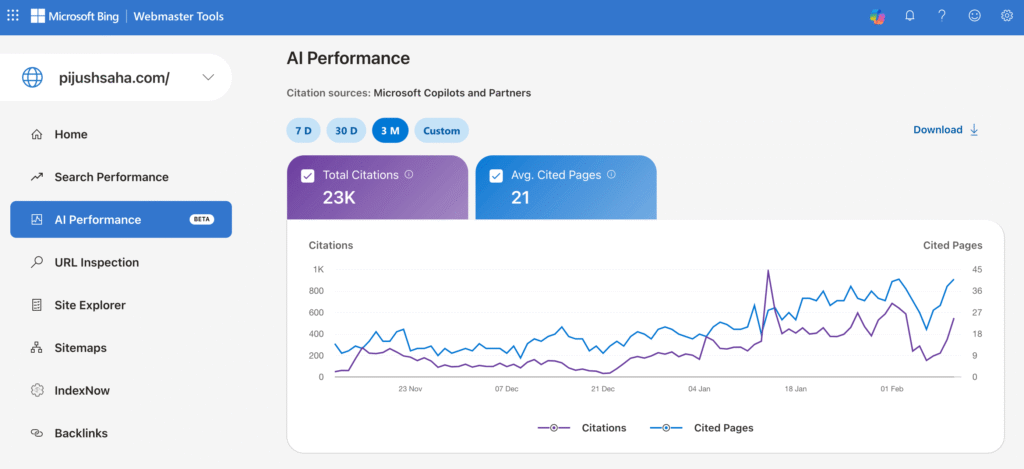
Microsoft introduced a new dashboard inside Bing Webmaster Tools called AI Performance.
It is the first dedicated reporting layer that tracks how your site is used in AI-generated answers across Bing’s AI experiences.
It moves beyond “blue links” to “AI citations.”
This marks the beginning of measurable AI attribution.
The 5 Core Metrics Explained (With SEO Context)
1. Total Citations (The New Impression Metric)
Definition: The total number of times your site is cited as a source in AI-generated answers.
Why It Matters
This functions like AI impressions.
It signals:
- Authority inside the model
- Trustworthiness
- Knowledge base inclusion
If rankings measure search visibility, citations measure AI trust.
2. Average Cited Pages (Breadth of Authority)
Definition: The daily average of unique URLs cited by AI systems.
Why It Matters
- Low number → AI trusts one strong page.
- High number → AI trusts your ecosystem.
This metric reflects topical authority depth, not just one high-performing URL.
For semantic SEO, this validates content clusters and entity coverage.
3. Grounding Queries (The Game Changer)
Definition: The specific conversational phrases that triggered AI to reference your content.
These are not traditional keywords.
They are:
- Natural language prompts
- Question-based triggers
- Problem-focused phrasing
Why This Is Critical for GEO
Grounding queries reveal:
- How AI interprets your expertise
- What topics you’re trusted for
- Which conversational intents activate your content
This is the clearest bridge between:
- Search behavior
- LLM reasoning
- Entity authority
4. Page-Level Citation Activity
Definition: Citation counts broken down by URL.
Example:
| URL | Citations | Trend |
|---|---|---|
| /blog/technical-seo-guide | 520 | ↑ |
| /products/analytics-suite | 310 | — |
| /support/api-docs | 150 | ↑ |
What This Reveals
- Which pages AI considers most reliable
- Which documents function as “knowledge anchors”
- Where structure and clarity are working
Pages with rising citation trends are often:
- Well-structured
- Fact-supported
- Entity-consistent
- Updated frequently
5. Visibility Trends Over Time
Definition: Timeline view of citation growth or decline.
Why It Matters
You can now track:
- Momentum after content updates
- Impact of entity expansion
- Authority shifts across topics
This is early-stage AI performance trend analysis.
The Critical Caveat: Citations ≠ Clicks
The AI Performance dashboard tracks:
- Citation frequency
It does not track:
- Traffic
- Click-throughs
- Conversions
- Revenue
You can see your content is being used — but you cannot yet directly attribute ROI from this data alone.
This is authority measurement, not performance marketing.
From SEO to GEO (Generative Engine Optimization)
Traditional SEO focused on:
- Ranking in blue links
- Capturing clicks
GEO focuses on:
- Being cited inside AI answers
- Becoming a trusted knowledge source
The sites that win won’t just rank. They’ll be the ones AI systems trust enough to cite.
This shifts optimization toward:
- Entity clarity
- Structured information
- Factual grounding
- Topical completeness
Actionable GEO Tactics (Based on Bing’s Framework)
1. Structure for Machine Readability
Use:
- Clear H2/H3 headings
- Lists
- Tables
- FAQ blocks
- Definition-style sections
AI systems extract structured segments more easily than dense prose.
2. Strengthen Factual Grounding
Support claims with:
- Data
- Sources
- Definitions
- Entity references
Avoid vague marketing fluff. AI models prioritize factual density.
3. Prioritize Freshness
Use IndexNow to push content updates instantly to Bing.
Fresh, updated content improves:
- Crawl speed
- Model grounding likelihood
4. Build Entity Consistency
Align:
- Page titles
- On-page copy
- Image alt text
- Schema markup
Ensure your site clearly communicates:
- What entity you are
- What topics you own
- What problems you solve
Consistency strengthens machine trust.
Bing vs Google: A Transparency Divide
| Platform | AI Citation Reporting |
|---|---|
| Bing Webmaster Tools | Granular AI citation data |
| Google Search Console | No dedicated AI citation reporting |
Microsoft has opened the reporting layer.
Google remains largely opaque regarding:
- Gemini citation logic
- AI Overview grounding data
- Source attribution analytics
The competitive message is clear:
Bing is positioning itself as the transparent AI ecosystem.
The Bigger Strategic Signal
Microsoft frames this as an early step.
But strategically, it means:
- AI systems are increasingly source-conscious.
- Attribution visibility is becoming a ranking signal.
- Authority is shifting from “position 1” to “citation 1.”
Winning sites will become foundational components of AI knowledge layers.
Your Immediate GEO Action Plan
- Log into Bing Webmaster Tools → AI Performance.
- Review Grounding Queries to identify conversational authority signals.
- Audit top Cited Pages for structure and clarity.
- Replicate successful formatting across content clusters.
- Apply insights to Google’s AI ecosystem strategy.
Final Takeaway
The shift from findable to recommendable is happening.
Search visibility is no longer just about ranking.
It is about becoming:
- Citable
- Trustworthy
- Structurally extractable
- Semantically authoritative
The era of measurable AI visibility has started.
And GEO is now a discipline — not a theory.