
There are over 600 million active blogs on the internet, and 77% of internet users, roughly 4.08 billion people, still read blogs regularly. Despite predictions of blogging’s demise, the content marketing industry has a market size of $417.85 billion in 2025 and is projected to reach $2 trillion by 2032. The average blogger earns $62,275 annually, with food bloggers reaching a median monthly income of $9,169.
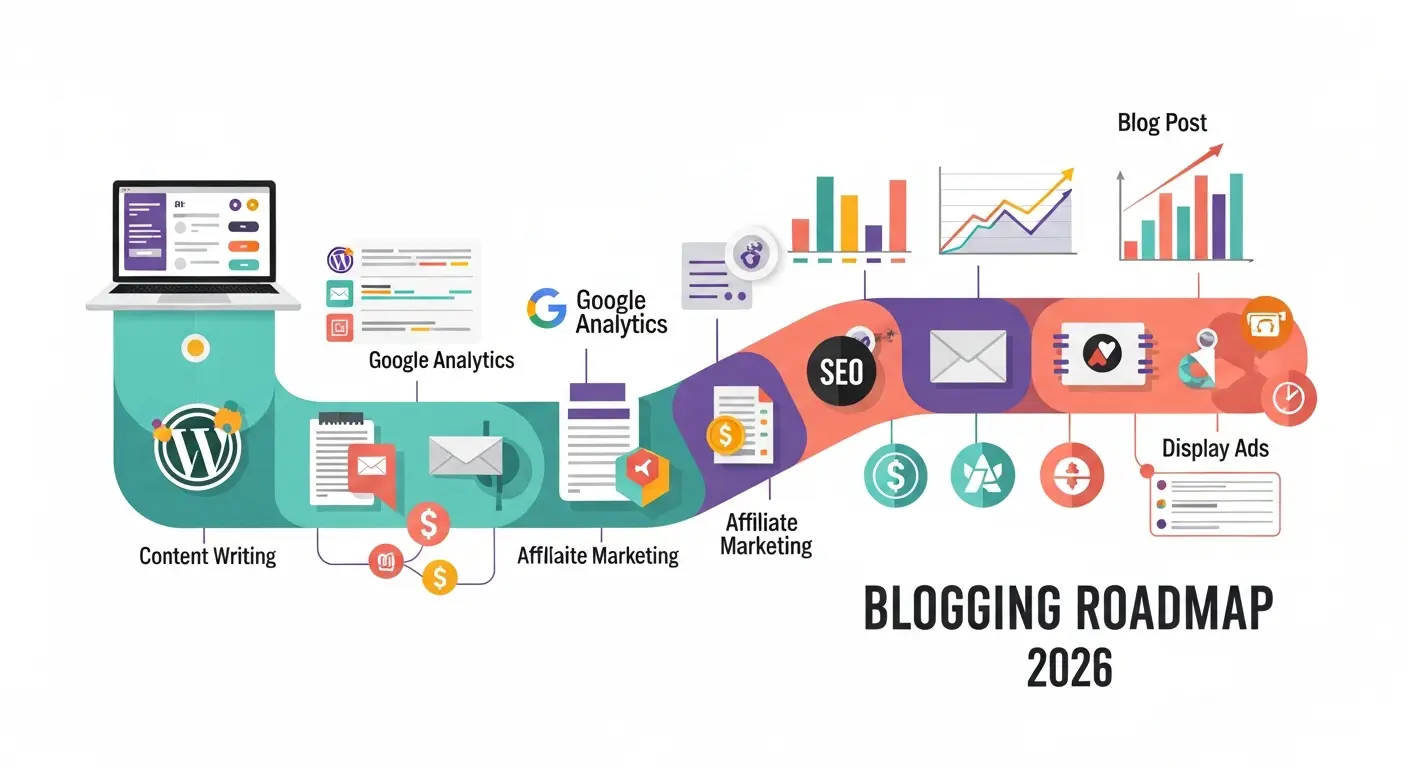
This blogging roadmap provides a structured path from choosing your niche and setting up your first blog to creating content that ranks, building an audience, and monetizing through multiple income streams. Whether you want to blog as a side hustle, build a full-time business, or establish thought leadership in your industry, this guide covers everything you need to succeed in 2026.
What Is Blogging?
Blogging is the practice of regularly publishing written content (blog posts) on a website, typically organized chronologically with the newest content appearing first. Modern blogging has evolved far beyond personal online journals. It’s now a legitimate business model and marketing strategy used by individuals and companies worldwide.
Professional blogging encompasses:
Content Creation: Writing informative, entertaining, or educational articles that serve a target audience’s needs and interests.
SEO Optimization: Structuring content to rank in search engines, driving organic traffic without paid advertising.
Audience Building: Growing an email list and social media following of engaged readers who return regularly.
Monetization: Converting traffic and audience into revenue through advertising, affiliate marketing, digital products, sponsored content, and services.
Types of blogs:
Personal blogs share individual experiences, opinions, and stories. Often passion projects with varied monetization potential.
Niche blogs focus on specific topics (food, travel, finance, parenting) with dedicated audiences. Highest monetization potential.
Business blogs support company marketing efforts, drive leads, and establish authority as part of a broader digital marketing strategy. B2B companies with blogs generate 67% more leads than those without.
Professional/portfolio blogs showcase expertise and attract clients for freelancers, consultants, and creative professionals.
Why Start a Blog in 2026?
The data supports blogging as a viable career and business strategy.
Strong reader demand persists. 77% of internet users regularly read blogs, and 68% of online experiences begin with a search engine. Blogs that integrate with websites generate 55% more traffic than sites without blogs. Despite social media growth, long-form content remains valuable for information-seekers.
Proven income potential. Bloggers make an average annual salary of $62,275. The most profitable niches, food ($9,169/month median), personal finance ($9,100/month), and lifestyle ($5,174/month), demonstrate that dedicated bloggers can earn full-time incomes. Bloggers with 1,000+ posts average $7,981.67 monthly income.
Low barrier to entry. Starting a blog costs $50-$200 for the first year (domain and hosting). No formal credentials required, just expertise, consistency, and willingness to learn. You can start while maintaining other employment and scale gradually.
Multiple monetization paths. Unlike platforms that control your income (YouTube algorithm, social media reach), blog owners control their revenue through diversified streams: display ads, affiliate marketing, digital products, sponsored content, consulting, and more.
SEO provides compounding returns. Unlike social media where content disappears quickly, blog posts can rank and drive traffic for years. A well-optimized article written today can generate passive income indefinitely.
Blogging Statistics (2024-2025)
| Metric | Value |
|---|---|
| Total blogs worldwide | 600+ million |
| Internet users who read blogs | 77% (4.08 billion) |
| Average blog post length | 1,427 words |
| Time to write average blog post | 3 hours 48 minutes |
| Blogs receiving 50K+ monthly sessions | 3.7% |
| Pages getting zero Google traffic | 96.55% |
| Blogs that fail within 18 months | 80% |
Traffic sources:
| Source | Percentage |
|---|---|
| Mobile devices | 63.3% |
| Organic search (Google) | 70-80% of blog traffic |
| Social media | 50% of bloggers’ primary source |
Blogger Income Guide (2025)
| Category | Average Income |
|---|---|
| Average blogger salary | $62,275/year |
| Freelance blogger (Glassdoor) | $72,068/year |
| Freelance blog writer hourly | $23.27/hour |
| Content writer salary | $53,748 – $83,956/year |
| Top freelance writers | $100,000 – $300,000/year |
Income by blog size:
| Blog Posts | Average Monthly Income |
|---|---|
| 50-99 posts | $205.31 |
| 100-299 posts | $1,000+ |
| 300-499 posts | $2,500+ |
| 500-999 posts | $5,000+ |
| 1,000+ posts | $7,981.67 |
Income by niche (median monthly):
| Niche | Median Income |
|---|---|
| Food | $9,169 |
| Personal Finance | $9,100 |
| Lifestyle/Mommy | $5,174 |
| Travel | $5,000 |
| Online Business | High (exact varies) |
Note: 2025 data shows bloggers need 300+ posts to earn $1,000/month consistently, up from 100+ posts in 2024. Content volume requirements are increasing.
Complete Blogging Roadmap: 8 Phases
Phase 1: Choose Your Niche and Validate (Week 1-3)
Your niche determines your audience, monetization options, and long-term success. Choose wisely.
Niche selection criteria:
Personal interest: Can you write about this topic for years without burning out? Passion matters for consistency.
Expertise or willingness to learn: Do you have knowledge to share, or will you document your learning journey?
Audience size: Are enough people searching for this topic? Use Google Keyword Planner to estimate.
Monetization potential: Are there products to promote, advertisers interested in this audience, or services you could offer?
Competition level: Can you realistically compete? Look for underserved angles in competitive niches.
Most profitable blog niches (2025):
- Food (42.8% of high-traffic blogs)
- Personal Finance
- Lifestyle (25% of new blogs target this)
- Travel
- Health and Wellness
- Home/DIY
- Parenting
- Technology
Validation process:
Search your potential topics in Google. Analyze existing blogs: can you provide something different or better? Check if affiliate programs exist in your niche. Look at ad rates (finance and insurance pay higher CPMs than entertainment).
Phase 2: Set Up Your Blog (Week 4-6)
Technical setup determines your blog’s capabilities and professional appearance.
Platform comparison:
| Platform | Best For | Cost | SEO |
|---|---|---|---|
| WordPress.org | Full control, monetization | $50-200/year hosting | Excellent |
| WordPress.com | Beginners wanting simplicity | Free – $45/month | Good |
| Ghost | Writers, newsletters | $15-35/month | Excellent |
| Substack | Newsletter-first writers | Free (10% of paid) | Limited |
| Medium | Casual writers, exposure | Free | Platform-dependent |
| Squarespace | Design-focused, beginners | $16-49/month | Good |
WordPress.org recommendation:
WordPress powers over 40% of all websites and 61.1% of B2B blogs. It offers unmatched flexibility through themes and plugins, full ownership of your content, and compatibility with all monetization methods. Most professional bloggers use self-hosted WordPress.
Essential setup steps:
- Register domain: Choose a memorable, brandable name. Cost: $10-15/year
- Purchase hosting: Recommended: SiteGround, Cloudways, or WPX. Cost: $3-25/month
- Install WordPress: Most hosts offer one-click installation
- Choose theme: Start with a clean, fast theme (GeneratePress, Astra, Kadence)
- Install essential plugins: Yoast SEO or Rank Math, caching plugin, security plugin
- Create core pages: About, Contact, Privacy Policy, Disclaimer
Phase 3: Master Content Creation (Week 7-14)
Content quality and consistency drive blogging success. The average blog post is now 1,427 words, 76% longer than 2014’s average of 808 words.
Content types that perform:
How-to guides are the most popular format, preferred by 74% of bloggers. They solve specific problems and attract search traffic.
Listicles are created by both high and low-income bloggers. Easy to scan and share.
“Everything You Need to Know” articles attract the most organic traffic on average, though only 0.4% of articles use this format.
Comparison articles attract high organic traffic (0.8% of articles use this format). Great for affiliate marketing.
Writing best practices:
- Hook readers in the first 100 words
- Use short paragraphs (2-4 sentences) for mobile readability
- Include images: articles with visuals attract 70% more traffic
- Add videos when possible. Only 8% of posts include video, but they significantly boost engagement
- Target 1,500-2,500 words for comprehensive coverage (though 75% of readers prefer articles under 1,000 words)
- Write for humans first, optimize for search second
Content frequency:
50% of bloggers publish weekly or several times per month. Bloggers who publish most frequently report the strongest results. Consistency matters more than volume, so establish a sustainable schedule.
Phase 4: Learn SEO for Bloggers (Week 15-22)
66% of bloggers use SEO, making it the primary traffic source for successful blogs. However, 96.55% of pages get zero organic traffic from Google, so proper optimization is essential.
Keyword research:
Use tools like Ahrefs, Semrush, or free alternatives (Ubersuggest, Keywords Everywhere) to find keywords with:
- Decent search volume (100+ monthly searches for new blogs)
- Manageable difficulty (under 30 KD for new blogs)
- Clear search intent (informational, commercial, transactional)
45% of marketers say researching and adding keywords boosts rankings.
On-page SEO essentials:
- Include target keyword in title, URL, and first 100 words
- Use header tags (H2, H3) to structure content logically
- Optimize meta descriptions (though Google rewrites 60-70% of them)
- Add internal links to related content
- Optimize images with descriptive alt text and compression
- Ensure mobile responsiveness and fast load times
Technical SEO basics:
- Submit sitemap to Google Search Console
- Fix broken links and crawl errors
- Implement HTTPS security
- Optimize Core Web Vitals (page speed, interactivity, visual stability)
Content that ranks:
Longer content correlates with backlinks up to 1,000 words (positive correlation). Beyond 2,000 words, there’s a moderate negative correlation between length and traffic, so don’t pad content unnecessarily.
Phase 5: Build Your Email List (Week 23-28)
Your email list is your most valuable asset. You own it regardless of algorithm changes or platform shifts.
Why email matters:
- Direct communication with your audience
- Higher conversion rates than social media
- Independence from platform algorithms
- Essential for digital product sales
Email list building strategies:
Lead magnets: Offer free resources (ebooks, checklists, templates, courses) in exchange for email addresses. Make them highly relevant to your content.
Content upgrades: Create bonus content specific to individual blog posts. These convert significantly better than generic lead magnets.
Exit-intent popups: Capture leaving visitors with compelling offers. Use sparingly to avoid annoying readers.
Embedded signup forms: Place forms within and at the end of blog posts, in sidebars, and on dedicated landing pages.
Email platforms:
| Platform | Free Tier | Best For |
|---|---|---|
| ConvertKit | 1,000 subscribers | Creator-focused features |
| Mailchimp | 500 subscribers | Beginners |
| Beehiiv | 2,500 subscribers | Newsletter-first blogs |
| MailerLite | 1,000 subscribers | Budget-conscious bloggers |
Phase 6: Monetize Your Blog (Week 29-38)
Diversify income streams for stability. Professional bloggers earning $7,500-$25,000/month generate 42.2% from affiliates, 33.3% from ads, and the rest from sponsors, courses, and services.
Display advertising:
The most popular monetization method. RPMs vary by niche and traffic source.
| Ad Network | Requirements | Best For |
|---|---|---|
| Google AdSense | No minimum | Beginners, any traffic level |
| Ezoic | No minimum | Growing blogs |
| Monumetric | 10,000 pageviews/month | Mid-size blogs |
| Mediavine | 50,000 sessions/month | Established lifestyle blogs |
| AdThrive (Raptive) | 100,000 pageviews/month | High-traffic blogs |
72% of bloggers earning $2,000+/month use Mediavine or AdThrive. These premium networks offer significantly higher RPMs than AdSense.
Affiliate marketing:
Promote products and earn commissions on sales through affiliate marketing. 42.2% of income for bloggers earning $7,500-$25,000/month comes from affiliates.
- Join relevant affiliate programs (Amazon Associates, ShareASale, individual brand programs)
- Write honest reviews and comparisons
- Disclose affiliate relationships (required by FTC)
- Focus on products you genuinely recommend
Digital products:
45% of bloggers earning over $50,000/year sell their own products, compared to only 8% of lower-income bloggers.
- Ebooks and guides
- Online courses
- Templates and printables
- Membership sites
Digital products offer the highest profit margins and aren’t dependent on traffic volume.
Sponsored content:
Brands pay for posts featuring their products. Average travel blogger charges $200 per sponsored post. Rates increase with traffic and influence.
Services:
Freelance writing, consulting, coaching, and done-for-you services leverage your expertise. Often the fastest path to income for new bloggers.
Phase 7: Grow and Scale (Week 39-44)
Once fundamentals are established, focus on growth strategies.
Content scaling:
Blogs with 1,000+ posts average the highest traffic (256,108 pageviews/month) and income. Consistency over years builds authority. Consider:
- Batch content creation for efficiency
- Guest posting for backlinks and exposure
- Content repurposing (blog → social → email → video)
- Hiring writers when revenue supports it
Traffic diversification:
Don’t rely on a single traffic source. Build presence across:
- Organic search (primary)
- Pinterest (especially for food, DIY, lifestyle)
- Email newsletter
- YouTube (video versions of content)
- Social media marketing on platforms relevant to your niche
Analytics and optimization:
Only 29% of bloggers regularly check analytics, a missed opportunity. Use Google Analytics 4 and Google Search Console to:
- Identify top-performing content (double down on what works)
- Find underperforming pages (update or consolidate)
- Track traffic sources and trends
- Monitor keyword rankings
Phase 8: Professional Development (Ongoing)
Stay current with industry changes and continuously improve.
AI and blogging:
80% of bloggers now use AI tools for content creation. Use AI for:
- Idea generation and research
- First draft creation and outlining
- Editing and optimization
- Image generation
But maintain your unique voice and expertise. AI assists, it doesn’t replace quality thinking.
Algorithm adaptation:
Google updates significantly impact blog traffic. The 5-10 year blog bracket saw income drop from $5,450.90 to $2,621.24 year-over-year, largely due to algorithm changes. Stay adaptable by:
- Following SEO news and updates
- Diversifying traffic sources
- Building brand recognition beyond search
- Focusing on E-E-A-T (Experience, Expertise, Authoritativeness, Trustworthiness)
Community and networking:
Join blogging communities, attend virtual conferences, and connect with other bloggers in your niche. Collaboration opportunities include:
- Guest posting exchanges
- Podcast appearances
- Joint ventures and product launches
- Masterminds and accountability groups
Essential Blogging Tools
| Category | Tool | Cost | Purpose |
|---|---|---|---|
| Platform | WordPress.org | Free (hosting separate) | Blog CMS |
| Hosting | SiteGround / Cloudways | $3-35/month | Website hosting |
| SEO | Yoast / Rank Math | Free – $99/year | On-page optimization |
| Keyword Research | Ahrefs / Semrush | $99-129/month | SEO research |
| Keyword Research | Ubersuggest | Free – $29/month | Budget alternative |
| ConvertKit | Free – $29/month | Email marketing | |
| Analytics | Google Analytics 4 | Free | Traffic analysis |
| Analytics | Google Search Console | Free | Search performance |
| Writing | Grammarly | Free – $12/month | Grammar and style |
| Design | Canva | Free – $12.99/month | Graphics and images |
| Speed | WP Rocket | $59/year | Caching and speed |
| Backup | UpdraftPlus | Free – $70/year | Site backups |
Blogging Education Resources
| Resource | Type | Cost | Focus |
|---|---|---|---|
| Smart Blogger | Blog/Courses | Free – $997 | Writing, monetization |
| Income School | YouTube/Course | Free – $449 | SEO, niche sites |
| Ahrefs Academy | Video courses | Free | SEO mastery |
| HubSpot Academy | Courses | Free | Content marketing |
| Google Skillshop | Courses | Free | Analytics, search |
| Blogging Wizard | Blog | Free | Strategies, tools |
| ProBlogger | Blog/Jobs | Free | Professional blogging |
Career Paths in Blogging
Independent blogger: Build your own blog as a business. Control content, monetization, and schedule. Income potential: $0 to $500,000+/year depending on niche, traffic, and monetization strategy.
Freelance blog writer: Write for other blogs and businesses. Average hourly rate: $23-$30. Top writers earn $100+/hour or $0.50-$2/word. Flexibility with client variety.
Content writer (employed): Staff positions at companies. Average salary: $53,748-$83,956/year. Benefits and stability, less creative control.
Content strategist/manager: Oversee content teams and strategy. Higher salaries ($70,000-$120,000+). Requires experience and proven results.
Hybrid approach: Many successful bloggers combine personal blogs with freelance writing, consulting, or courses for diversified income.
Frequently Asked Questions
How long does it take to make money blogging?
Most bloggers see minimal income in the first 6-12 months while building content and traffic. Meaningful income typically begins at 12-24 months with consistent effort. To earn $1,000/month in 2025, data suggests you need 300+ quality posts. However, bloggers focusing on digital products can monetize earlier with smaller audiences.
Is blogging still profitable in 2026?
Yes, but it requires more effort than before. The average blogger earns $62,275/year, and top niches like food and finance generate $9,000+/month. However, 80% of blogs fail within 18 months, and 96.55% of pages get zero Google traffic. Success requires quality content, SEO knowledge, and patience.
How much does it cost to start a blog?
Minimum costs: $50-$100/year for domain and basic hosting. Realistic first-year budget: $200-$500 including a premium theme and essential tools. You can start lean and reinvest profits into better tools and resources as you grow.
What’s the best blogging platform for beginners?
WordPress.org (self-hosted) offers the best long-term flexibility and monetization options. For complete beginners prioritizing simplicity over control, WordPress.com or Squarespace require less technical setup. For newsletter-focused writers, Substack or Ghost provide integrated email tools.
How often should I publish blog posts?
Consistency matters more than frequency. Publishing 1-2 quality posts per week is sustainable for most bloggers. Data shows bloggers who publish most frequently report strongest results, but quality should never sacrifice for quantity. Start with a sustainable schedule you can maintain long-term.
Should I use AI to write blog posts?
80% of bloggers now use AI tools. AI can assist with research, outlining, drafting, and editing. However, purely AI-generated content often lacks the personal expertise and voice that builds audience trust. Use AI as a tool to enhance your process, not replace your unique perspective.
Key Takeaways
- 600+ million blogs exist, but 77% of internet users still read blogs
- Average blogger salary is $62,275/year; food bloggers earn $9,169/month median
- Need 300+ posts to reliably earn $1,000/month in 2025 (increased from 100+ in 2024)
- 42.2% of professional blogger income comes from affiliate marketing
- 72% of bloggers earning $2,000+/month use Mediavine or AdThrive
- WordPress powers over 40% of all websites, the dominant platform choice
- 80% of blogs fail within 18 months; consistency is the key differentiator
- Content marketing industry projected to reach $2 trillion by 2032
Your Next Steps
Start by choosing your niche and validating demand through keyword research. Purchase a domain and hosting, then install WordPress. Create 10-20 foundational posts before focusing heavily on promotion.
Learn SEO fundamentals through free resources like Ahrefs Academy or Moz’s Beginner’s Guide. Implement basic on-page optimization from your first post.
Set up Google Analytics 4 and Search Console immediately to track progress from day one. Start building your email list with a simple lead magnet.
Don’t wait until you have significant traffic to think about monetization. Join relevant affiliate programs early and naturally incorporate recommendations into helpful content.