
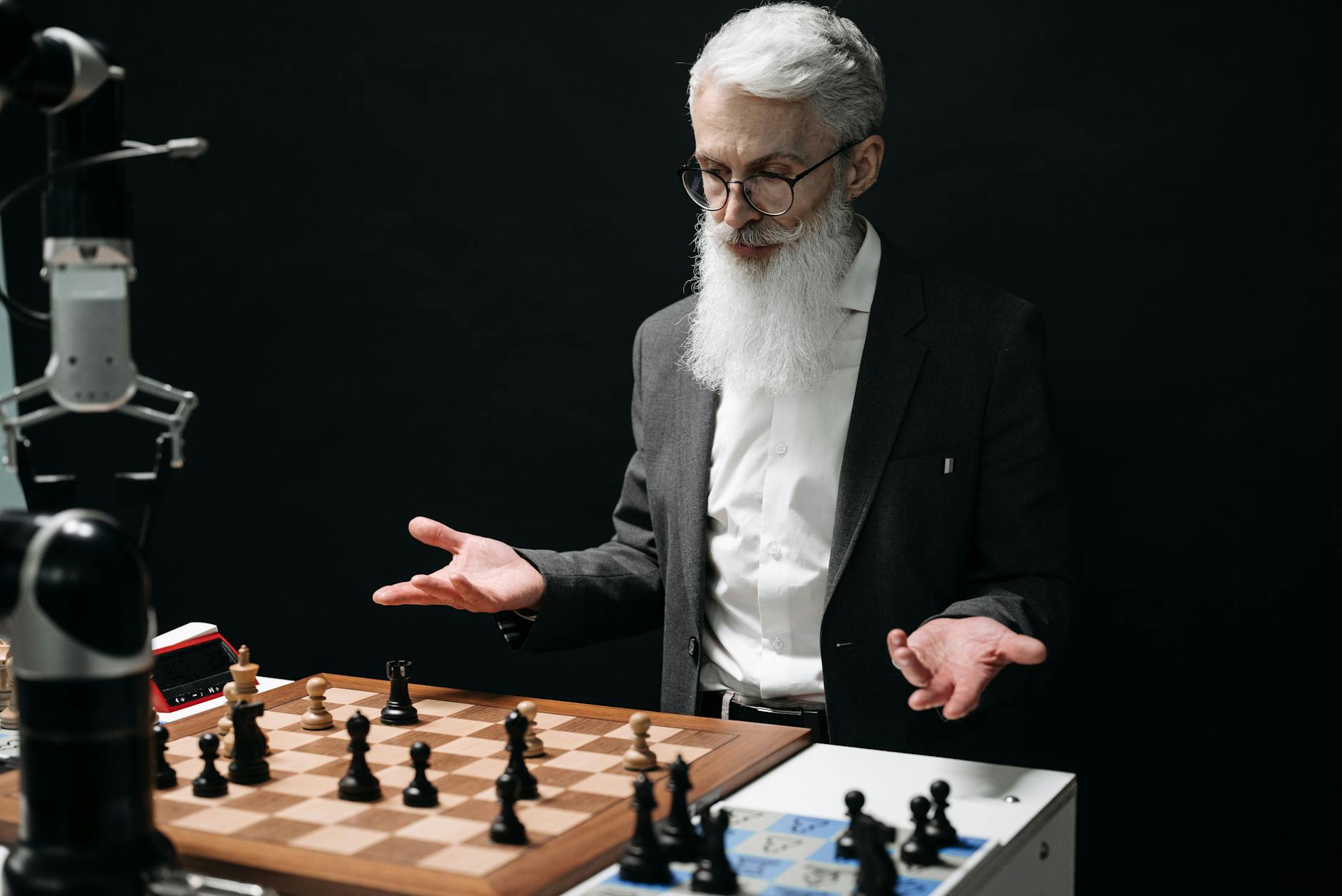
Games have become the training ground for the next generation of artificial intelligence. From chess computers that beat grandmasters to poker bots that outsmart professional players, strategic reasoning in games is pushing AI development into new territory.
The connection between games and AI runs deeper than you might think. Games provide perfect testing environments where AI systems can learn complex decision-making without real-world consequences. Every move teaches the system something new about strategy, risk, and long-term thinking.
This approach is changing how we build smarter AI systems. Instead of programming rules, developers now create AI that learns strategy through millions of game scenarios. The results are AI systems that can handle uncertainty, plan ahead, and adapt to opponents in ways that mirror human thinking.
The Big Picture
Strategic reasoning represents a fundamental shift in AI capabilities. Traditional AI systems follow predetermined rules and patterns. Game-based AI must create its own strategies based on incomplete information and changing conditions.
Think about playing poker. You don’t know what cards your opponents hold. You must read their behavior, calculate odds, and decide when to bluff. This type of reasoning requires skills that go far beyond simple pattern recognition.
AI researchers have discovered that games teach machines to think strategically in ways that translate to real-world problems. A system that masters strategic reasoning in games can apply those same skills to business negotiations, financial planning, or medical diagnosis.
What Is Driving This Trend
Several breakthrough technologies are making game-based AI training more powerful than ever before. Multi-agent reinforcement learning allows AI systems to compete against multiple opponents simultaneously. This creates more complex scenarios that better mirror real-world decision-making.
Neural networks have also evolved to handle the massive amounts of data generated during game play. Modern AI systems can process millions of game scenarios and extract strategic patterns that would take humans years to discover.
Computing power plays a crucial role too. Cloud-based training systems can run thousands of games in parallel, allowing AI to learn from diverse scenarios much faster than before. What once took months of training now happens in days.
Game theory itself has advanced significantly. Researchers now understand how to structure games that teach specific types of strategic thinking. This allows them to design training environments that develop particular AI capabilities more efficiently.
Real Examples in Action
AlphaGo’s victory over world champion Go players in 2016 marked a turning point in AI development. The system didn’t just memorize game patterns. It developed creative strategies that human players had never considered.
OpenAI Five demonstrated strategic reasoning in team-based environments by mastering Dota 2. The AI learned to coordinate with teammates, adapt to opponent strategies, and make split-second decisions that required understanding complex game dynamics.
Financial institutions now use poker-trained AI systems for algorithmic trading. These systems excel at making decisions with incomplete market information, just like they learned to do with hidden cards in poker games.
Military simulations employ game-trained AI for strategic planning. The AI can evaluate multiple scenarios, predict opponent responses, and recommend tactical approaches based on strategic reasoning learned through gaming environments.
Healthcare applications are emerging where game-trained AI helps doctors make treatment decisions. The strategic thinking learned through medical simulation games helps AI weigh different treatment options and their potential outcomes.
Key Advantages of Game-Based AI Training
Games offer unique benefits that other training methods cannot match. Here’s why this approach is so effective:
- Safe environment for experimentation without real-world risks
- Immediate feedback on every decision made
- Unlimited scenarios for testing different strategies
- Clear success metrics for measuring improvement
- Ability to scale difficulty as AI capabilities grow
The controlled nature of games allows researchers to isolate specific aspects of strategic thinking. They can focus on teaching AI systems about bluffing, long-term planning, or risk assessment without the complexity of real-world variables.
Games also provide rich datasets that capture human strategic behavior. AI systems can learn not just optimal strategies, but also how to predict and counter human decision-making patterns.
Where This Is Heading
The future of AI development will likely depend heavily on advances in strategic reasoning through games. Researchers are working on more sophisticated game environments that teach multiple types of strategic thinking simultaneously.
Multi-modal games that combine visual, textual, and numerical information are becoming more common. These environments better prepare AI systems for real-world scenarios where information comes in many different formats.
Collaborative games are teaching AI systems to work with humans rather than just compete against them. This skill will become increasingly important as AI systems take on more supportive roles in human decision-making.
The integration of strategic reasoning with other AI capabilities is accelerating. Systems that combine game-learned strategy with natural language processing and computer vision are already showing promising results in complex problem-solving scenarios.
Industry adoption is expanding beyond tech companies. Traditional businesses are beginning to recognize the value of AI systems trained through strategic games for improving their decision-making processes.
Challenges and Limitations
Game-based AI training faces several important limitations that developers must address. Games simplify real-world complexity, which means AI systems may struggle when faced with scenarios that don’t match their training environment.
The computational costs of training AI through games remain high. Running millions of game scenarios requires significant processing power and energy resources that not all organizations can afford.
Transfer learning between different types of games is still challenging. An AI system that excels at chess may not apply those strategic skills effectively to poker or business negotiations.
Ethical considerations are emerging as game-trained AI systems become more sophisticated. The strategic thinking that makes AI effective in games could potentially be misused for manipulation or deception in real-world applications.
Frequently Asked Questions
How do games actually improve AI strategic thinking?
Games provide structured environments where AI systems can make decisions, see immediate results, and adjust their strategies accordingly. Through millions of game scenarios, AI learns to recognize patterns, predict outcomes, and develop long-term planning skills that apply beyond gaming.
What types of games are most effective for AI training?
Strategy games with incomplete information work best, such as poker, Go, and complex video games. These games require AI to make decisions without knowing all variables, which mirrors real-world decision-making scenarios more accurately than perfect-information games like chess.
Can game-trained AI systems work in business applications?
Yes, many companies already use game-trained AI for trading, negotiations, and strategic planning. The strategic reasoning skills learned through games translate well to business scenarios that involve uncertainty, competition, and long-term planning requirements.
What are the biggest challenges in using games to train AI?
The main challenges include high computational costs, difficulty transferring skills between different game types, and ensuring that game-learned strategies work effectively in real-world situations. Additionally, games may oversimplify the complexity and unpredictability of real-world scenarios.
How long does it take to train AI through gaming?
Training time varies greatly depending on game complexity and desired skill level. Simple games may require days or weeks, while complex strategic games can take months of continuous training across multiple high-powered computer systems to achieve expert-level performance.